
Disclaimer: Robbie Powelson worked with the attorneys who represented the Plaintiff in Alfred v. City of Vallejo.
On October 15, the Ninth Circuit Court of Appeals upheld its first preliminary injunction to halt an encampment sweep since the Supreme Court’s decision in Grant Pass v. Johnson, which ended Eighth Amendment protections for unhoused people across the United States.
The Ninth Circuit’s decision sets a precedent for future challenges against encampment sweeps under the Fourteenth Amendment’s “State-Created Danger Doctrine,” a constitutional protection that has garnered new persuasive authority in the post-Grants Pass era.
The decision came down after the three-judge panel unanimously dismissed the City of Vallejo’s appeal, finding the case had become moot since the plaintiff, Evelyn Alfred, had moved into housing and her former self-constructed home on Mare Island Way no longer existed.
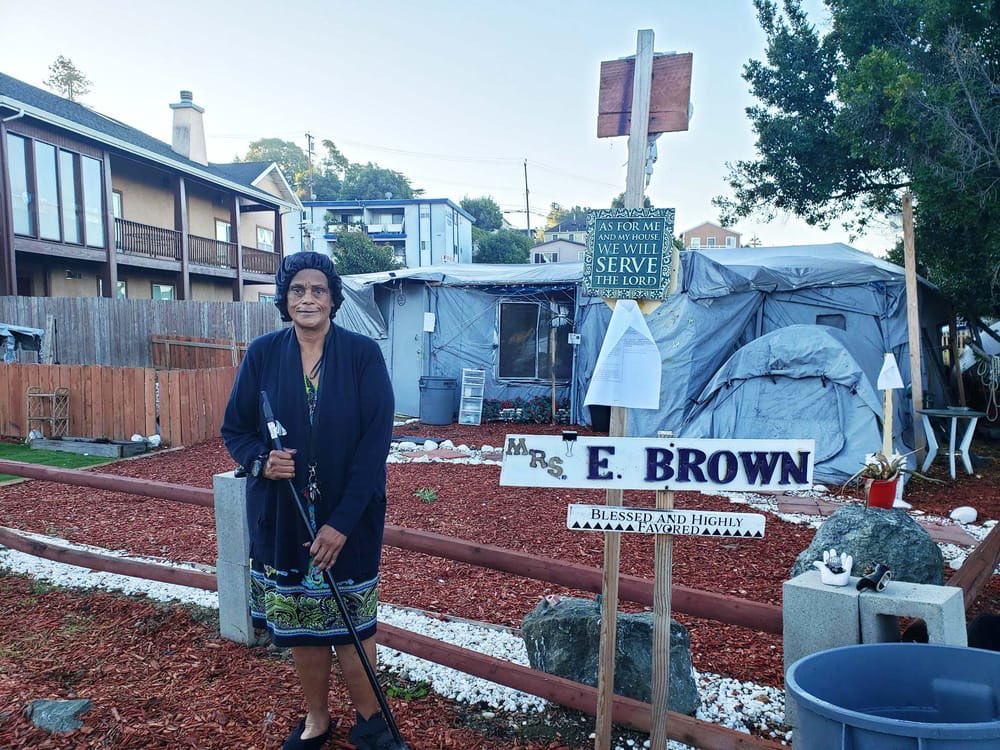
The lawsuit arose when Alfred, aka “Brown Sugar,” was subject to an abatement order issued by the City of Vallejo in November of 2024. Alfred is a great grandmother, widow, and mother of five children, and has lived unhoused for around two decades. When she was younger, Alfred worked in construction and maintained housing until she was subject to an eviction. Her only source of income came from her deceased husband’s Social Security benefits—around $1,100 per month.
“I work hard to be a good neighbor and I have good relationships with the people around me,” Alfred explained to the court, attaching photographs of her self-constructed home complete with a clean, fenced front yard decorated with religious symbols and a sign that read “Blessed and Highly Favored.”
In court filings, Alfred explained that she suffers from severe osteoarthritis and osteomyelitis in her shoulder and ankle, as well as a degenerative disk disease.
“It’s hard for me to move around and I am constantly in pain,” Alfred wrote. “I require the use of a cane, a walker, a back brace, and a medical boot… I even have a hard time dressing myself.”
The City ignored her disability accommodations request to stop the eviction. In response, Alfred filed a federal lawsuit without an attorney, seeking a temporary restraining order (TRO). Shortly after the lawsuit was filed, Vallejo city officials visited Alfred at her home and told her that they would delay the abatement until December 2, 2024. The court denied Alfred’s request for a TRO on the basis that an abatement extension had been granted.
However, Alfred injured her ankle while preparing for the looming abatement—an unsurprising accident given that she suffers from osteomyelitis, a type of bone infection. On November 20, she was admitted to the emergency room for the ankle injury and received a doctor’s note that outlined her medical condition. Alfred also submitted dozens of notes from nearby housed neighbors in support of her request for more time, but the City of Vallejo did not agree.
On November 27, a few days before the scheduled eviction, Alfred filed a new lawsuit requesting reasonable accommodation under the Americans with Disabilities Act, as well as relief from the State-Created Danger Doctrine—which prohibits the government from affirmative acts that place people in foreseeable danger.
Alfred used a template lawsuit and motion for restraining order designed for self-represented litigants to obtainthe initial temporary restraining order. With support from the Vallejo Homeless Union and its President Eli Smith, Alfred also reached out to Where Do We Go? and the California Homeless Union for further legal assistance, which included support from Andrea Henson and Anthony Prince, the latter offering general counsel for the case.
“No matter what, I will lose my shelter,” Alfred stated in court documents, “My shelter provides me privacy, which also gives me safety. I am an elderly, single woman on my own, and if I am forced to be visible I am at risk of becoming a target. My shelter provides protection from the elements, and an accessible place for me to move around given my disabilities.”
“The last time I had to live in my car, I believe it was [June 2021],” she continued, “I was raped and robbed. I was in my car, asleep, and I woke up with someone hitting my window. I saw it was a gun. He told me to open the door, I opened the door. He then raped me and took all of my money.”
Alfred’s home had locking doors, offering both privacy and protection necessary for her continued safety. US District Judge Denise Coggins agreed, granting a TRO to block the abatement of Alfred’s home. Additionally, Judge Coggins ordered the parties to enter settlement discussions and begin a process of locating alternative housing that would accommodate Alfred’s injuries and disabilities. If that didn’t work, the Court would make a final decision on the preliminary injunction.
The interactive process culminated in a face-to-face meeting between Alfred, the California Homeless Union, and attorneys with the City of Vallejo. Alfred requested specific accommodations during the meeting, including access to a bathroom that would be accessible with her medical boot and walker, which were rejected by Vallejo City Attorney Hampton Jackson. The City and Alfred were at an impasse.
Shortly after the interactive process ended, both parties updated the court on their failed attempts to resolve the lawsuit through interactive process and settlement. Judge Coggins held a hearing, and found that the city’s failure to mitigate dangers associated with Alfred’s eviction—and without any shelter offer or additional assistance—amounted to deliberate indifference under the State-Created Danger Doctrine, writing:
While Plaintiff has made substantial efforts to locate housing through both public and private services, and is actively working with homeless union members to secure alternative shelter or housing, the record before the court does not demonstrate that Defendant City has made a good faith effort to connect Plaintiff with housing resources.
In addition, the court found Alfred would face “increased risk of exposure to the elements, especially during the winter season, aggravation of her disabilities which limit mobility, risk of physical injury, exposure to sexual violence, and a credible fear [from] previously [being] victimized.”
As a result of the court’s findings, a preliminary injunction was entered to protect Alfred and her home. The city promptly appealed to the Ninth Circuit to overturn, but by September 2025, Alfred reported to the court that she had obtained permanent housing and had moved out of her self-constructed structure.
Additionally, Alfred—who had often been subjected to harassment—reported that an act of arson ultimately destroyed her home on Mare Island Way. Because of this, the Ninth Circuit upheld the district court’s decision, dismissing the city’s appeal and stating that the “preliminary injunction no longer has any coercive force because the encampment at issue no longer exists”.
Although the Ninth Circuit decision was based on Alfred’s new permanent housing status—not the preservation of her home on Mare Island Way—the ruling will serve as a precedent in district courts across the nation, setting an example of what is possible under the State-Created Danger Doctrine. While not controlling precedent, it offers unhoused Americans the persuasive authority to maintain their rights, and enjoin governments from violating their safety in a post-Grants Pass world.
Robbie Powelson is a California-based homeless advocate involved in civil rights litigation on behalf of unhoused individuals throughout the state.