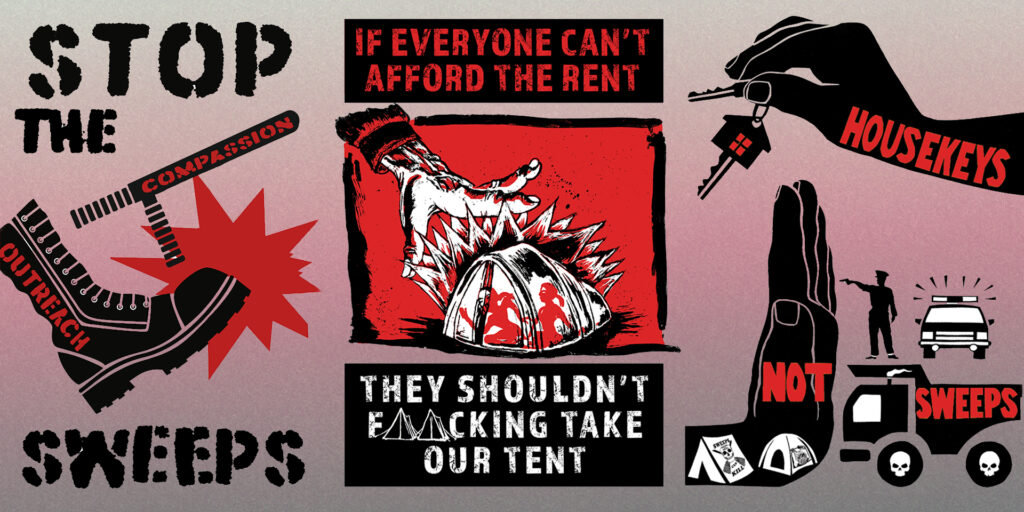
Everyone is familiar with encampment sweeps, be it by definition, bearing witness to someone’s displacement, or coming across a familiar place and noticing people who used to live there are suddenly gone. Sweeps happen daily in our communities. Despite new policies, rhetoric, and media portrayals of sweeps and city government’s asinine excuses for doing them, the underlying reality of their impact on people’s lives stays the same. Sweeps are dehumanizing, violent, and in no way indicative of people receiving services or housing. Simply put, sweeps criminalize people who can’t afford a decent place to live. So, we fight back against them.
Since day one, community-based outreach will always be the principal factor in identifying the priorities and direction of campaigns for both the Western Regional Advocacy Project (WRAP) and our members. When WRAP started the House Keys Not Sweeps campaign in 2019, we knew we had to fight hard to advocate for what’s real out in the streets, so we also launched the WRAP-wide Sweeps Street Outreach Initiative. Through documentation, discussion, and constant feedback, the campaign reflects the impacts of sweeps that are intentionally overlooked and receive little to no coverage.
As of today, 300 outreach forms have been compiled by organizers going into unhoused communities to document peoples’ experiences. The data we’ve collected in our outreach reflects the communities in six cities, and the universal trends among them affirm what has been clear from the beginning: Sweeps displace people from their community, much like anti-Okie and sundown town laws back in the day.
At best, cities treat unhoused communities as a nuisance, but more often than not they’re seen as pests that must be rid of. People have a right to exist, as well as the right to decency and respect. But sweeps achieve nothing more than violently and abruptly interrupting peoples’ lives, and perpetuate cycles of criminalization that unhoused communities face simply for being unhoused.
In our outreach, the number one reason people were given for why a sweep was happening was simply no reason at all. 78 percent of survey participants reported that police conducted the sweep of their encampment, usually threatening arrest, citations, warrant checks, and being verbally abusive. When it came to their personal property, a staggering 85 percent weren’t offered a place to store their belongings, and 74 percent had their personal property trashed.
There’s a widespread misconception that homeless people continue to refuse services—the belief that, “If a bed, cot, or mat in a shelter was being offered then people had no reason to be in the streets.” But this hollow line of thinking gets called out for the BS it is when 88 percent of people reported not receiving offers for any type of shelter or services. So long as this myth of available shelter continues, rampant criminalization will remain a core tenet of the strategy to address the US housing crisis.
At its core, violent displacement is rooted in a fundamental disregard for a person’s humanity. When asked what’s important for the larger community to understand about sweeps, the number one reported answer was simply “We are human.”
Sweeps were never meant to be a viable solution to addressing homelessness. As the federal government decimated funding for public housing, they absolved themselves of responsibility by decentralizing the efforts to states and cities. And the truly scary thing is we are seeing more and more sweeps as the numbers of unhoused people keep growing under the Big Fascist Bill (H.R. 1).
When homelessness emerged in the early 1980s, it was mislabeled as a short-term, one-time crisis. The Federal Emergency Management Agency (FEMA) began to prop up emergency shelters to address this “disaster.” This calamity was not going to be solved with a single rollout of shelters: they couldn’t guarantee a bed for everyone due to bureaucratic labyrinths and the often racist, anti-immigrant intake criteria to qualify for eligibility people were forced to navigate
As homelessness continues to expand, so do the opportunities for financial and political gain. Businesses and city officials alike utilize local law enforcement to enforce the hostile removal of unhoused individuals from public spaces. Other extensions of law enforcement are private security and sanitation firms, who have secured contracts and deals that easily line their pockets off the continued dehumanization of poor people.
Access to legal counsel and legal resources remain an additional barrier that prevents unhoused communities from breaking free of the criminalization they face. In spite of the fact that 78 percent outreach participants reported that sweeps of their encampments were carried out by pigs and 95 percent said they were unable to access legal support, community organizers have taken it upon themselves to think creatively about how to bridge the gap between what is needed and what is available.
For 20 years, organizers at Los Angeles Community Action Network (LACAN) in Skid Row have partnered with lawyers to fight criminalization there. WRAP and our friends at the National Homelessness Law Center created the Legal Defense Clinics Project, an initiative to form relationships between lawyers and local organizers to better provide legal counsel. Groups in San Jose and Sacramento have already adopted similar models. In Seattle, organizers have developed relationships with law students to develop a method of tracking property loss, which has resulted in campaigns against the police department for property destruction in unhoused communities.
Our efforts to ensure people’s right to exist in public spaces is still faced with a fixed system that is not interested in undoing itself. There is no viable solution being offered for housing, and 73 percent of our outreach participants reported receiving stay away orders from the neighborhood they were swept from.
Temporary solutions like shelters do not get to the root of the underlying issues of homelessness and poverty. Shelters come with their own issues, such as a total lack of privacy, not allowing pets, arbitrary or punitive exits, and inaccessibility to disabled individuals, just to name a few. These short-term “solutions” fail time and time again, and it’s unhoused people who continue to face the consequences of a broken system.
The issue of homelessness is a man-made farce. It is easier for those in power to create grotesque caricatures of people who simply “don’t want to work” or who “refuse help” than to take accountability and solve the problem. Mainstream reporting on homelessness in this country is just an additional mechanism of disinformation meant to absolve the state of any accountability. This wack “journalism” is more interested in fueling the dehumanization of a community rather than uplifting its humanity.
Targets on the backs of our communities have been magnified as a means to justify the intensified attacks we’re subjected to. We can not ignore the hostilities against poor, Black, Brown, immigrant, disabled, queer, or any other intentionally marginalized community. We are left with no other viable choice but to band together and fight back as if our asses depend on it—because they do!
Forty years of policy changes, punitive measures, and divestment from housing, food, healthcare, and income support is proof that America’s neoliberal approach to fiscal and social policy is the number one reason homelessness continues to grow exponentially.
Sweeps won’t fix this, only a total re-evaluation of how our government respects and cares for its people will. The alarm has been sounding off, and we must answer the call. The only way through the current fascistic hellscape is together!
Editor’s Note: An abridged version of this story appeared in Street Spirit Vol. 32, No. 5.
The Western Regional Advocacy Project (WRAP) is a coalition of social justice organizations working together to expose and eliminate the root causes of civil and human rights abuses of people experiencing poverty and homelessness in our communities.