Julia Vinograd was Berkeley’s informal “poet laureate.” Her poems about Telegraph Avenue and life in Berkeley were beloved by many. She died in December 2018.
Julia Vinograd, the acclaimed poet laureate of the Berkeley streets, truly lived up to her title. For over 50 years, she sold her work on Telegraph Avenue, forming a close-knit community with people on the street. Her work encompassed the experiences of impoverishment—the collective suffering of being unseen, the fire of protest, the warmth of community.
She wrote countless odes to street folk—to artists, spare-changers, and outcasts. She wrote poems to the street itself: its noise, its heartache, its beauty. Her poems memorialized beloved public spaces, like People’s Park, while pleading for their protection.
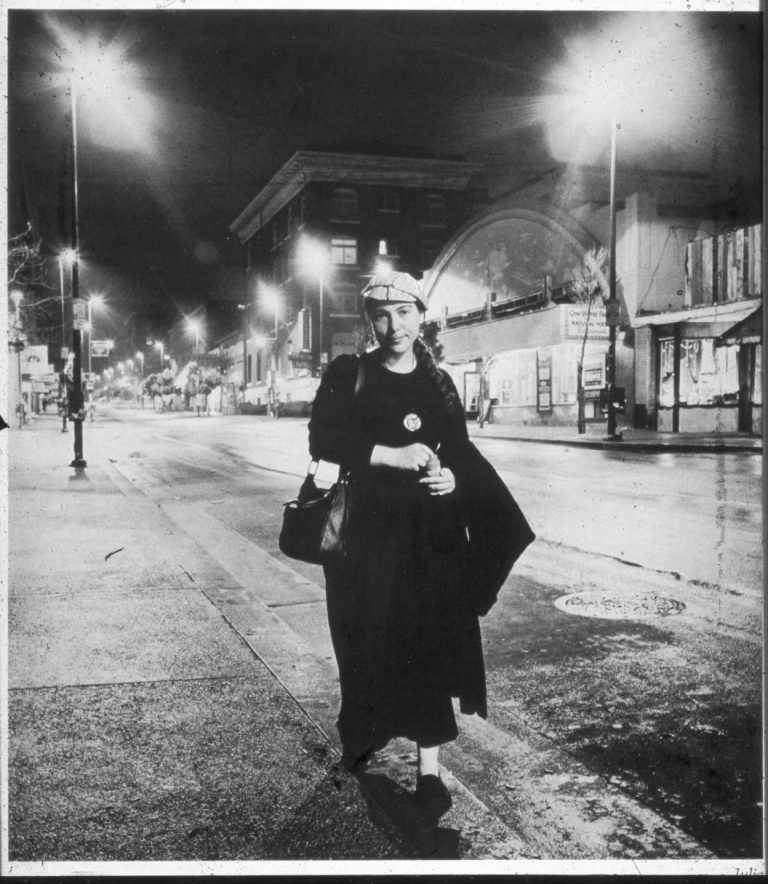
Capturing a suffering she knew from the inside out, Vinograd’s portraits of street life expanded into the fantastical. Throughout her work, she deeply entwined myth into her portrayal of life on the street, magnifying the spiritual tie between people and place.
Vinograd’s most beloved poems call for the protection of People’s Park from the university’s demolition. Rather than viewing land through a capitalistic lens, as property to be exploited at one’s will, Vinograd’s poems posit the park as woven in myth, reverence, and spiritual power, underscoring the profound interconnection between land and the community it sheltered.
In November 1967, UC Berkeley acquired the land of People’s Park—previously low-income housing—through eminent domain. After demolishing the block and displacing low-income students in the process, the university lacked the funds to properly rebuild on the site. Taking the cultivation of public space into their own hands, the Berkeley community of students, residents, and activists united together to create People’s Park. On May 15, 1969, thousands of National Guardsmen seized the land without warning, hospitalizing 128 people and killing student James Rector in the process. The day would become known as Bloody Thursday.
Yet the park’s protectors remained steadfast. In May of 1972, amidst escalating protests against the Vietnam War, thousands of demonstrators successfully tore down the eight-foot chain-link fence that had enclosed the lot for three years. In December, the Berkeley City Council negotiated with the UC, allowing the city to manage part of the land as a public park, temporarily ending the university’s policy of keeping the lot vacant and enclosed.
However, the university resumed their effort to control the land in the early 1990s by building fee-based volleyball courts. In 1991, during the “Volleyball Riots,” activists passionately protested the installation. While the volleyball courts were successfully torn down in 1997, by 2000 the UC chose to end its joint-management deal with the city.
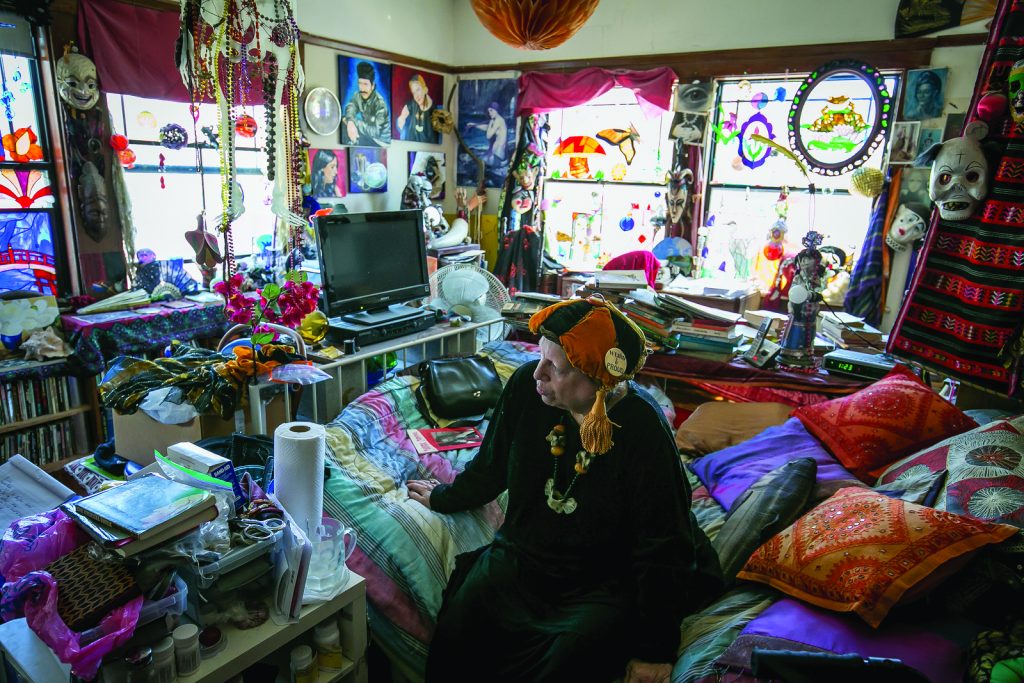
In the decades following Bloody Thursday, UC Berkeley made relentless attempts to destroy the communal space, including the continuous removals of the park’s free food programs, children’s play structures, public restrooms, and community garden. The people of the park always fought back, always regrouped, replanted, and rebuilt.
Yet after 55 years of fighting, the university seized the land by force in January 2024. Approximately $7 million was spent to assert ownership, funding 24-hour police surveillance and a perimeter of stacked shipping containers to block off all entry.
While the physical park no longer stands, its spirit is memorialized through Vinograd’s work. Through mythologizing the land, Vinograd illuminates the spiritual breadth of the very people the university sought to silence.
By sanctifying public space as sacred ground in her verse, the park’s destruction does not merely signify a change in landscape, but reverberates consequences in the mythic realm. In the following three odes to People’s Park, we come to understand displacement as a violation of the soul.
Anniversary Party at People’s Park (2015)
Drummers on stage,
circles of people whirling,
rags and feathers.
We’re a tribe, we’re on the cover
of National Geographic
where native women
carry baskets on their heads,
bare breasts swaying.
We don’t have any baskets,
we’ve got some basket cases
and a few girls shrug their shirts off
while freckles pour down from the sky.
A bottle of red wine goes around
a circle of reddening faces,
brighter than blood.
Broken teeth grin.
Beer cans blossom.
Enough spills for our thirsty ghosts.
Lovers’ hands get big and blurry.
We’re a tribe,
we move in mystic circles,
like the drunk said when the cop
told him to walk a straight line.
Damp grass licks our feet
like a puppy’s tongue.
Half the people here
can’t do anything but magic
and magic dissolves in the rain.
It rained yesterday,
it will rain tomorrow
but today we’re having a party
in the hole of a hostile donut.
The thing about the park is
you can’t just go there
unless the park comes out to meet you.
Today it has.
We’re a tribe.
In spite of a sound system from hell
we’re using the music to climb ourselves
like dancing up a rusty fire escape
to steal the fire.
from Handle with Care, Zeitgeist Press, 2015.
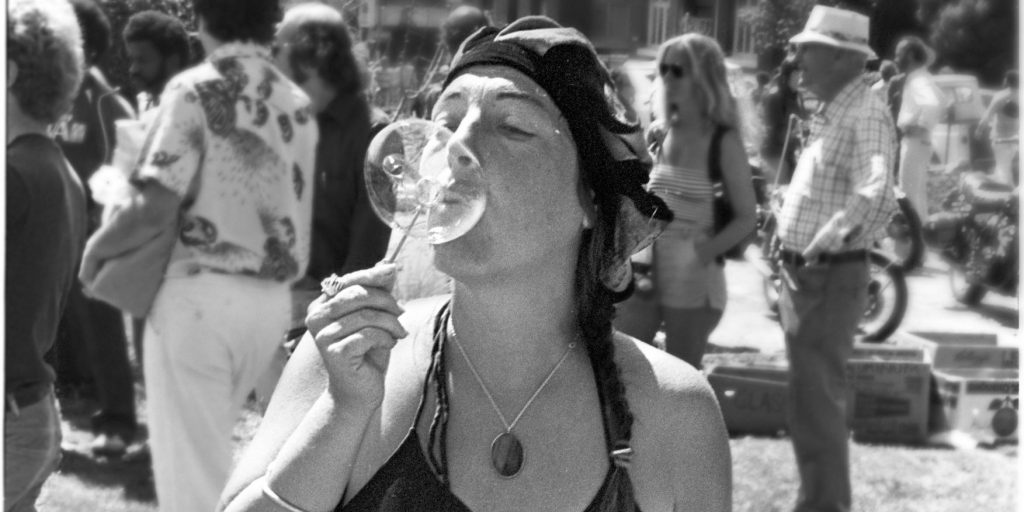
“Anniversary Party at People’s Park” is a whirlwind of mythic motion as Vinograd describes drumming, whirling dancers, swaying bare breasts, and spilt beer for thirsty ghosts. She captures the community’s vibrating spirit:
We’re a tribe, / we move in mystic circles, / like the drunk said when the cop told him to walk a straight line.
The drunk’s remark humorously acknowledges his reason for stumbling, not his drunkenness but rather his defiance of formal order to embrace liberating movement. Vinograd then recognizes the resilience and transitory nature of People’s Park’s inhabitants, writing:
Half the people here / can’t do anything but magic / and magic dissolves in the rain. / It rained yesterday, / it will rain tomorrow / but today we’re having a party / in the hole of a hostile donut.
Rain symbolizes the harsher realities of poverty. It leaves unhoused people vulnerable to the cold, it dampens the spirit. Berkeley is metaphorized into a “hostile donut,” a comical dig at the police officers who antagonize the people of the street. But today, the community is in the “hole”—warm, safe, and celebrating. This imagery holds the oppressive pangs of poverty while simultaneously elevating the tribe’s lively spirit.
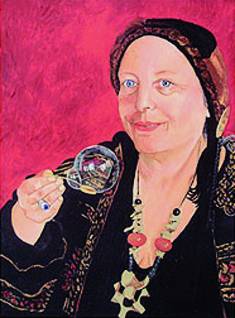
Vinograd then anthropomorphizes the park, asserting the land as an independent, living spirit that eclipses superficial notions of ownership:
The thing about the park is / you can’t just go there / unless the park comes out to meet you. / Today it has.
The poem transcends focus from the repressive conditions of poverty, the exposure of the elements, and police brutality to the welcoming spirit of the land. By asserting that the park must “[come] out to meet” the tribe, Vinograd elevates the park’s 20th anniversary party from a temporary gathering to a ritualistic communion. While the conditions of poverty can often deteriorate the soul, the park’s acceptance grants the community a temporary sacred immunity, allowing their magic to thrive.
The poem concludes by elevating the community’s defiance into a profound act of spiritual triumph:
In spite of a sound system from hell / we’re using the music to / climb ourselves / like dancing up a rusty fire escape / to steal the fire.
The tribe turns the oppressive loudness of cops’ sirens and thunderstorms into a danceable tune. The image of “climbing ourselves” up a “rusty fire escape” transfigures the act of dancing into a metaphor for collective elevation. To “steal the fire” evokes the Greek myth of Prometheus, who rebelliously stole fire from the gods to gift humanity with warmth—and light to see beyond the darkness. This allusion symbolizes the defiant reclamation of their magic, a magic that sets their souls ablaze. Vinograd celebrates the tribe’s ability to forge unity by mystically transforming the elements of their struggle into the very fuel for their resilience.
People’s Park 1991 (1991)
The university just built a volleyball court
on my youth. I watched.
The net was woven of my hair
when my hair was long enough to sit on.
The ball was my head
when my head bounced everywhere
and was never on my shoulders very long.
I know this happens to everyone.
Sometimes it’s a department store
on top of a table where a candlelight dinner
is still going on.
Or a parking garage with a ghost tree
growing thru it
and someone waiting beside the tree,
still breathing hard because he ran all the way
and just got there
as Toyotas drive thru his side
and leave no wound.
Why should my youth be different than any other,
just because it’s mine?
I can feel the slaps on my young face
when the volleyball players hit their ball,
she isn’t used to it.
Why are strangers beating on her?
She doesn’t have any money.
The police shot at her, but that’s different.
And then there’s a crowd
and the police are shooting at us
and the bullets didn’t get any older.
James Rector is the same age
as when they killed him 20 years ago.
Broken windows. Screams.
She can’t believe this is happening.
I’m ashamed that I can.
I can’t find anything to say to her,
not a single word.
This time there is no tear gas
to excuse my tears.
from Eye Contact Is a Confession, Zeitgeist Press, 1991.
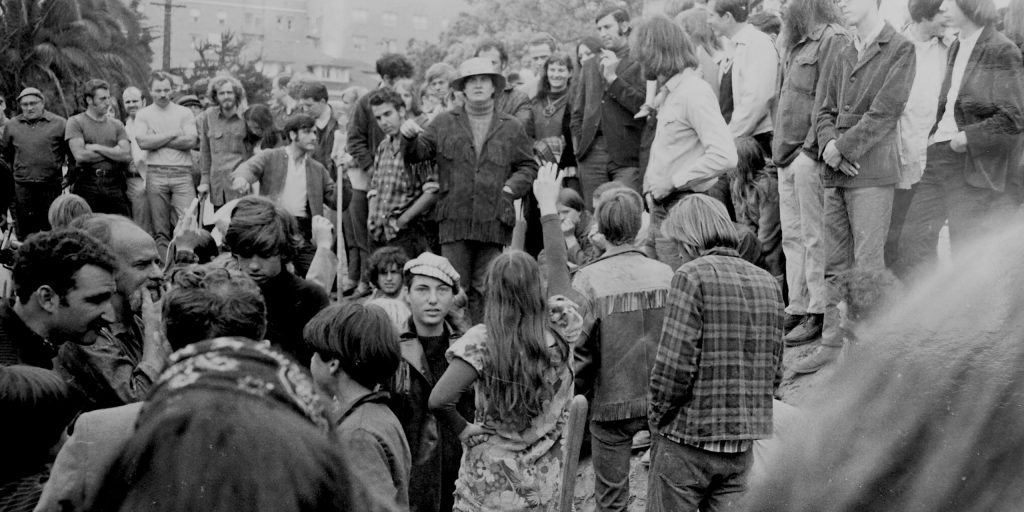
In “People’s Park 1991,” Vinograd critiques the university’s forceful appropriation of the park by violently transmuting her younger self into the structure of the newly built volleyball court. The ghost of her free-spirited past is now mutated and bound, as she writes:
The net was woven of my hair / when my hair was long enough to sit on. / The ball was my head / when my head bounced everywhere / and was never on my shoulders very long.
She juxtaposes images of the commodification of her body for the university’s profit with her carefree youth. What was once long, free-spirited hair is now a tightly restrained net for a monetized purpose. She continues, intensifying the violation:
I can feel the slaps on my young face / when the volleyball players hit their ball, / she isn’t used to it. / Why are strangers beating on her? / She doesn’t have any money.
The metaphor of a decapitated young woman’s head being slapped around by students elevates the seemingly insignificant act of university expansion into a violent beheading, a profound violation of the spirit. These graphic metaphors depict the university’s expansion at the expense of the park’s spirits, the street spirits of the Sixties who cultivated the grounds on the bedrock of liberation. By metaphorically weaving herself into the volleyball courts, Vinograd cements the mutilation of land as a mutilation of self.
Because the soul, transcendent of all physical limitations, is interwoven into sacred ground, it bends the chronology of time. In “People’s Park 1991,” Vinograd memorializes the land by writing of the ghosts who inhabit modern infrastructure of sacred ground’s past. This imagery portrays the layering of events in time, as everything happening at once. Vinograd spotlights Bloody Thursday in 1969, the violent day of protest when police shot and killed James Rector:
And then there’s a crowd / and the police are shooting at us / and the bullets didn’t get older. / James Rector is the same age / as when they killed him 20 years ago.
Myth conveys the incomprehensible spiritual truths of the soul, where past and present cease to exist. The bullets and Rector are the same age, as the memory of the event is living inside the land. When we view a place as transcendent of chronological time, it holds the weight of everything that happens within it. Not only in memory, but in contemporaneity.
People’s Park, 20th Anniversary (1989)
The wizards in old tales
used to bury their hearts in secret places.
And unless you dug up the heart and destroyed it,
they were invulnerable and heartless.
Part of my heart is buried in People’s Park.
Not all of it, not even the largest part.
Other places, people and I’m no wizard
so I keep some of it myself.
Part of my heart is buried in People’s Park.
Leave it alone.
It’s the part that will never be reasonable,
never grow up and know better
and do worse.
It’s young;
breathing is sweet to it, and wild and scary.
It remembers meeting soldiers’ bayonets with daffodils.
It remembers tear-gas drifting over swing sets.
It will always be young.
Leave it alone.
I go to the park sometimes to talk to it.
Not often. Time passes
and it doesn’t always recognize me.
But it tells me there are many hearts
buried with it.
All young, all proud of what they made
and fought for. Do not disturb them.
Do not build on them.
Do not explain that times have changed.
Do not tell them it’s for their own good.
They’ve heard that before.
They will not believe you.
There are many hearts buried in People’s Park
and a part of my own as well.
Oh, leave them alone.
from Cannibal Carnival, Zeitgeist Press, 1996.
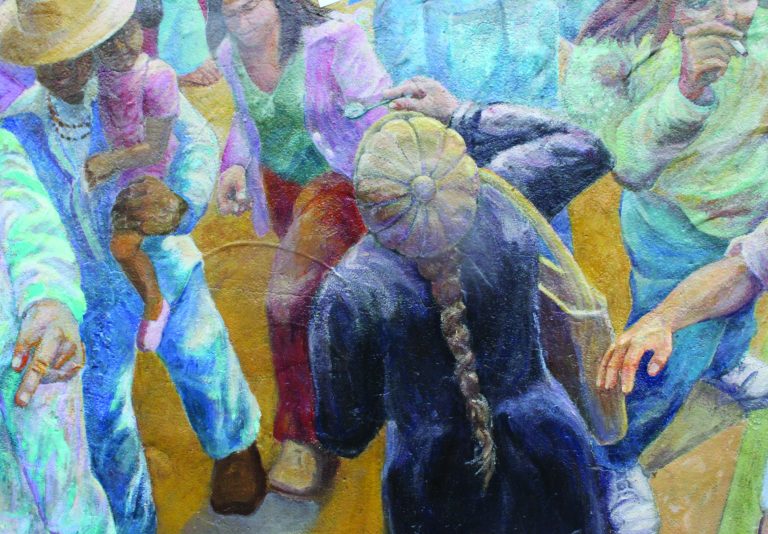
Vinograd’s most treasured poem, “People’s Park,” binds the spirit to the land through the metaphorical burial of hearts beneath the park’s soil. Vinograd pleads:
Part of my heart is buried in People’s Park. / Leave it alone.
This poetic metaphor resonated deep within the community, and was painted on the streets the day the park was demolished as one final outcry for protection. Vinograd’s anthropomorphized heart tells her:
there are many hearts buried with it / All young, all proud of what they made and fought for.
These are the hearts that poured their souls into building the park, that shed blood for the land when the National Guard inflicted brutal force. Vinograd begs:
Do not disturb them. / Do not build on them.
The heart is arguably the most vulnerable part of the body; it symbolizes love, emotion, the core of one’s being. Vinograd’s metaphor of buried hearts, an archaic ritual grounded in the spiritual significance of place, reveals the pain of destroying sacred land. Vinograd’s mythologization of People’s Park conveys that the displacement of impoverished people from their land is not just an ethical violation, but a deeply spiritual one—a metaphorical beheading, a bulldozing of hearts that chose to be buried beneath sacred soil.
Memorialized in Myth

People’s Park was a refuge for poor people, it was a place where outreach programs provided food and clothing, a place for community, a home. In turn, the people cared for the land by cultivating gardens, by dancing in mystic circles, by protecting it with every cell of their being until the very last moment of defeat. Vinograd’s poems treated the land as a living entity, as part of her own body. The tethered connection between spirit and place is embodied by the telling of myths.
When we mythologize land, it becomes harder to destroy. When we view our parts as connected to the land, when it transcends space and time, when it holds trauma in its very roots—it comes alive. It becomes something greater than us. Vinograd’s poems were a method of seeing beyond the visible, an exploration of the deeper truths that demand to be brought into the light—truths so expansive in their pain and beauty they refused to be confined within the mundane. While the regents of the university likely weren’t reading Vinograd’s poems, the people of the street were, and their connection to the land is honored through her work.
Lauren Lutge recently graduated from UC Berkeley with a degree in English and a love for salsa dancing. She’s the senior editor of The Berkeley Pulse, with a passion for leading creative writing workshops. In her free time, she befriends every dog she meets.