
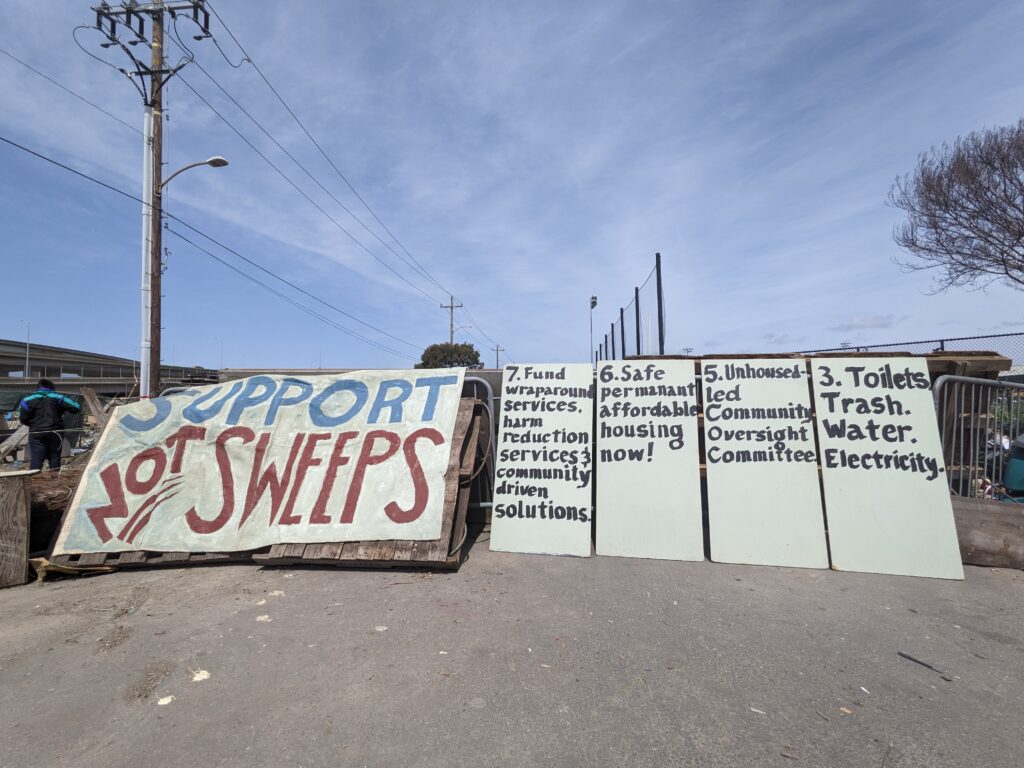
Oakland City Council voted on April 14 to adopt the Encampment Abatement Policy, which will allow the city to ramp up encampment evictions and tow more inhabited vehicles without providing access to services. The policy also allows Oakland police to remove RVs outside of official encampment operations, meaning they have no obligation to work with outreach providers. With several interim housing programs having closed this year or closing imminently, and this policy allocating no additional funding for shelter or housing, more people will be subject to state violence, forced displacement, and dispossession with fewer options to attain safety and stability.
Community advocacy resulted in several amendments of the original Encampment Abatement Policy proposal, including not arresting or citing residents for camping, providing prior notice for tows, identifying land for future safe parking and interim housing, expanding “low sensitivity zone” designations, allowing increased trash removal from encampments, and developing additional procedures for disability accommodations and unhoused families with children. Some amendments, however, are more hostile to the unhoused.
Council President Jenkins included a provision for council members and the city administrator to expand “high-sensitivity zones” where encampments are banned in response to anti-homeless complaints. The policy provides a new map of these zones that makes the vast majority of the city off-limits to the unhoused. Despite modest concessions to community demands, the EAP amounts to the city doubling down on what they’re already doing during encampment operations—what experts, advocates, and the unhoused know doesn’t work.
It is widely recognized in public health and public policy literature that sweeps don’t end homelessness, but in fact make it harder to exit homelessness. In addition to making it nearly impossible to manage chronic health conditions, the destruction of medication and medical devices, and disrupted connection to care providers, repeated evictions cause people to lose essential documents they need to eventually move into affordable housing. It is commonly reported that family members, advocates, and case workers lose contact with individuals who experience displacement, and some of those individuals pass away before they are found again.
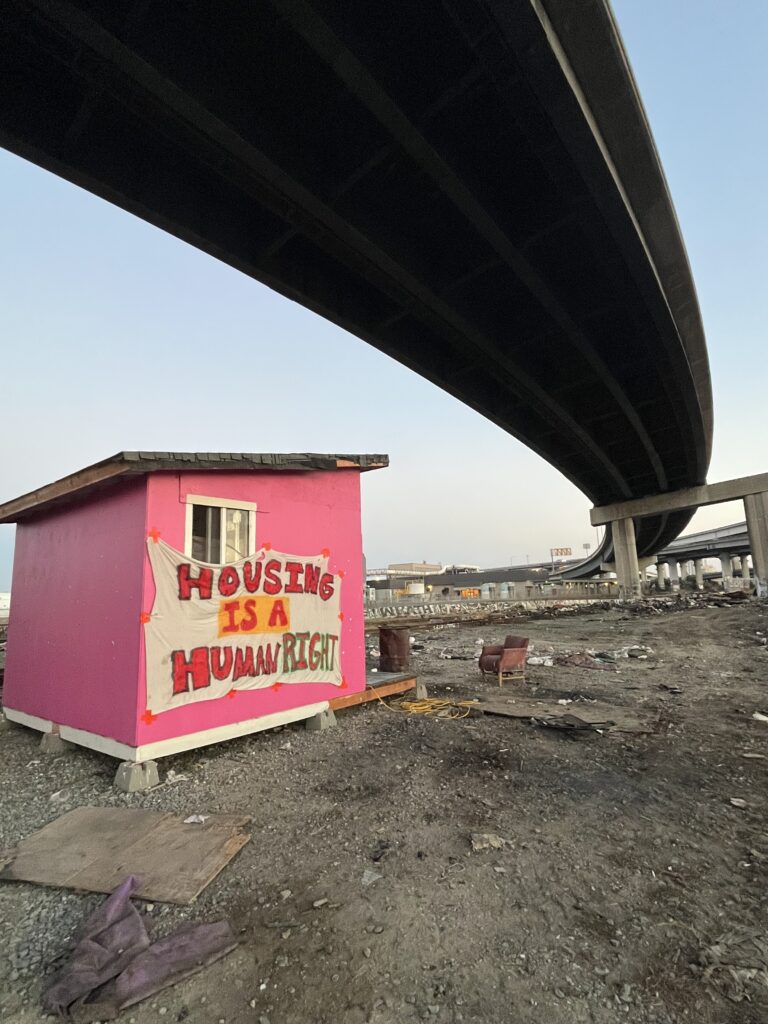
Public health researchers have often connected sweeps to heightened health risks, and the American Medical Association documented that repeated displacement may increase unhoused deaths by 15 to 25 percent. In addition to these health harms, sweeps and tows have been found by courts to violate Fourth and Fourteenth amendment due process protections against the confiscation of essential property and exposure to state-created danger. Civil rights experts have also demonstrated that anti-homeless ordinances perpetuate the racist legacies of Jim Crow, sundown towns, Indian removal laws, and “ugly laws” that discriminated against people with disabilities. With 200 unhoused people dying in Oakland each year and an unhoused mortality rate that’s 5.4 times greater than the general population, our response should be to protect rights and increase care delivery, not scapegoat and collectively punish the most marginalized population.
Grassroots groups led by currently and formerly unhoused people like Wood Street Commons, Homefulness, The Village, and Rise have developed proposals for self-governed, sweeps-free sanctuary communities, where unhoused residents can have refuge from violence and gain stability, structure, access to health care, and housing navigation. These proposals are based on knowledge from lived experience of unhoused-led community organizing, and informed by best practice and case study literature.
Self- or co-governance models are consistent with the goals of Oakland and Alameda County’s homelessness strategy, which include “lowering programmatic barriers” and “increasing resident autonomy” in order to improve service delivery and mitigate racial disparities caused by access barriers. According to a UC Berkeley Goldman School report, self-governed sites that incorporate resident labor have proven to be cheaper than traditional shelters, as they require less administrative costs and full-time staff.
Encampment operations are currently diverting funding from essential services towards enforcement actions that do nothing to end homelessness. Despite a budget crisis leading to multiple shelter closures, unbudgeted sweeps have increased over the past year. According to a 2021 audit of Oakland’s encampment management interventions, the Encampment Management Team’s daily operations cost at least $1,500 per hour.
Towing residential vehicles, closing shelters, and demolishing communities only worsens the unsheltered crisis, and ultimately increases costs of health care and emergency services down the line. A wealth of literature demonstrates that housing is less costly and more effective at crime prevention than criminalization. We need to redirect money spent on evictions towards community-based solutions that actually lead to housing.
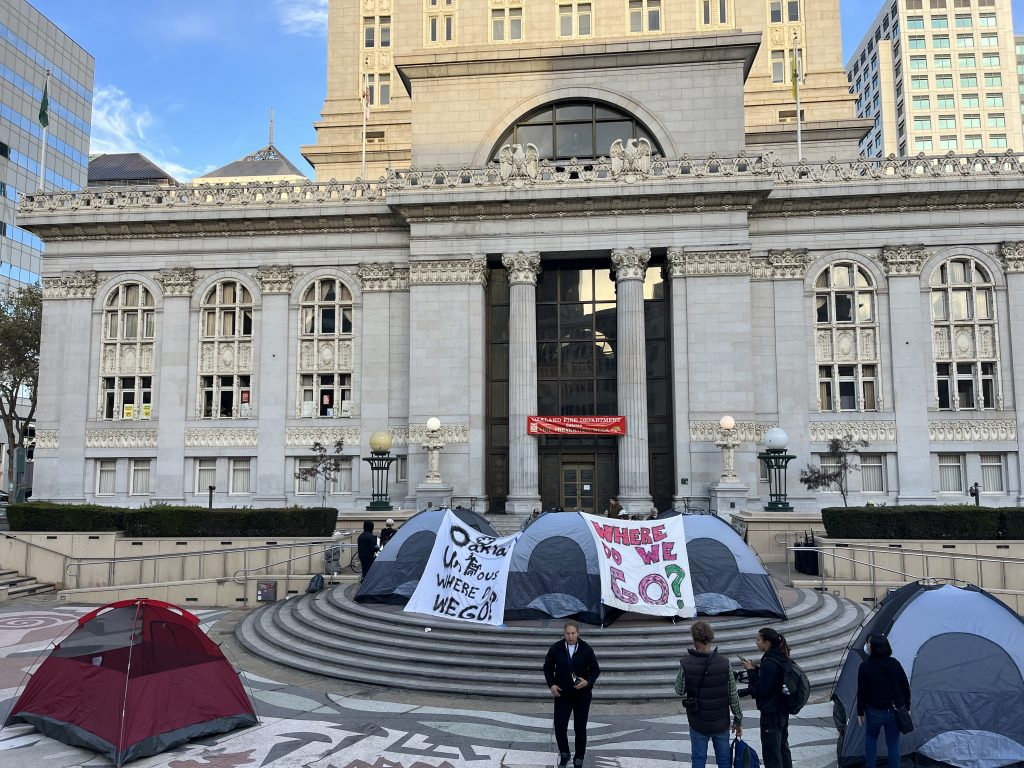
In this Trumpian age of misinformation and hate, public officials have felt comfortable promoting stigmatizing, non-fact-based narratives about unhoused communities. Councilmembers, administrators, and police captains have worked to create a constant association of the unhoused with crime, even though research has shown that encampments are not the source of crime and evictions make the unhoused more likely to be victims of crime. Those same officials claim that unhoused individuals are dangerous outsiders invading from San Francisco, Portland, and the Midwest, but data from the Alameda County Point-in-Time Count and the UCSF Statewide Study show that 75 to 80 percent of unsheltered people reside in the same communities where they became unhoused.
In my time doing encampment support, countless residents have told me that their families owned houses and they went to school on the very same streets where they now live unsheltered. Oakland is where their family, friends, and support networks are located. Houseless people still have homes, which are their communities and their city. These multigenerational residents, who are disproportionately black and elderly, are the heart and soul of Oakland, holding its historical memory and embodying its radical legacy.
Houselessness cannot be solved as long as financial institutions treat land and housing as vehicles of speculative investment rather than as social goods. There are more than enough vacant—albeit, unaffordable—housing units to provide housing to all if they weren’t being hoarded and kept empty by corporate landlords to artificially inflate rents. Until housing is converted from the market to the social sector, we will live in a system that continues to make masses of people unhoused.

We need a social housing agency that purchases distressed rental properties and transfers them to land trusts to guarantee permanent affordability. The lived experience and indigenous-led group Homefulness already provides rent-free housing through radical redistribution and rematriation. Moms 4 Housing liberated a vacant home through direct occupation. Wood Street Commons and the Village provided sanctuary, resources, and community to the unhoused through self-determination and mutual aid before their brutal forced evictions, and continue their advocacy, outreach and survival programs today. All these groups have faced active hostility from our city government, but what they need is support. Poor-people led movements are actualizing concrete solutions. It’s time for policymakers to take notice and follow their leadership.
Editor’s Note: An earlier version of this story was published on Street Spirit’s website in April 2026.
Armando Solorzano does encampment support and policy advocacy in Oakland, working with Wood Street Commons, Love and Justice in the Streets, and East Oakland Collective.