
Vehicle homes are no longer considered “encampments” in Oakland, and the city can now require encampment residents to move without first offering them shelter, in some circumstances.
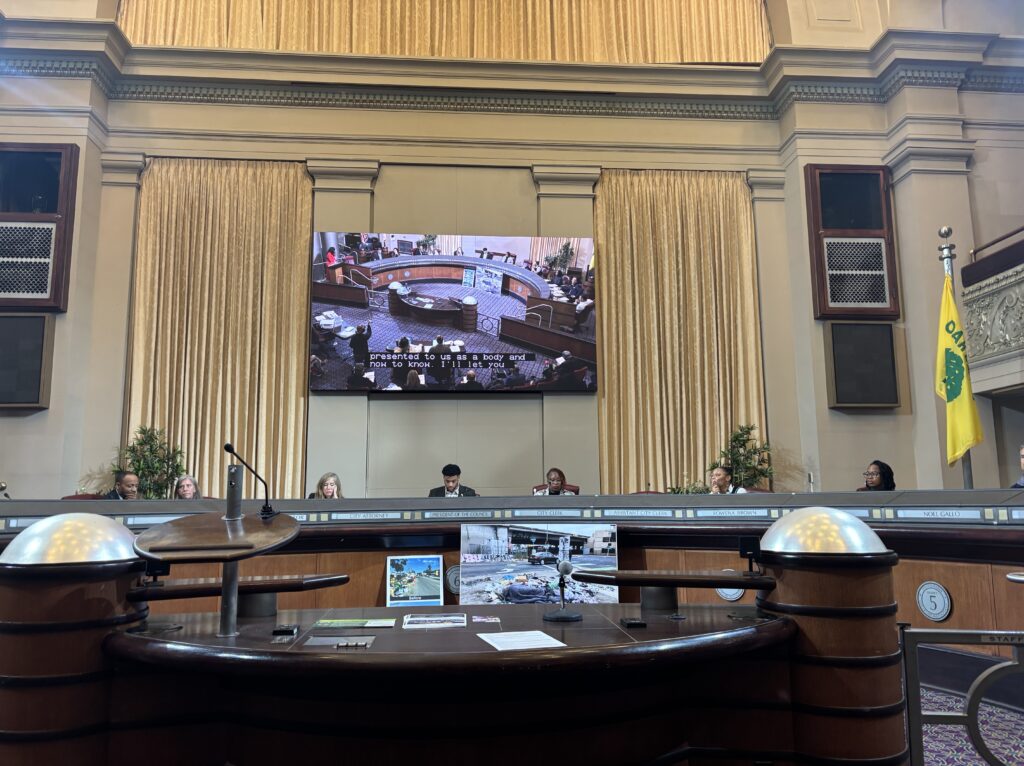
These are the major changes enacted by Oakland’s new Encampment Abatement Policy (EAP), which passed in a 5–1 vote by the city council during a special meeting on April 14. They represent a controversial revision of the “Encampment Management Policy”—the set of rules that had governed the city’s response to unsheltered homelessness since 2020.
The new policy represents a victory for District 7 Councilmember Ken Houston, who has been trying to push the changes through since last September. Houston’s initial drafts articulated a zero-tolerance policy on homelessness that would have made it possible for unhoused people to be fined or arrested for sleeping outside. While the council softened Houston’s harsh initial drafts with amendments that established stronger protections for unhoused residents, some of its defining tenets remain intact.
Vehicles

Fifty-eight percent of unhoused people in Oakland live in vehicles. Previously, vehicle dwellers were considered encampment residents: When the city wanted them to move, the designated Encampment Management Team (EMT) followed the same procedure they would for unsheltered people living in tents or self-made structures. The goal was to provide advance notice of the closure, make offers of available shelter, and store one cubic yard of their personal belongings for 90 days.
The Encampment Abatement Policy writes vehicles out of the city’s definition of encampment altogether. This means that they will be under the jurisdiction of the police, who are instructed to enforce the California Vehicle Code on RVs and vehicle homes in the same way they do for uninhabited cars: Those that are parked in one location for more than 72 hours will be towed.
Police officers are encouraged to connect vehicle dwellers to shelter, offer property storage, and to “consider” allowing them to move their vehicle to another location before towing, but are not required to do so.

Amauri Collins-McMurray, who has worked on the EMT since around 2021, said the goal was to shrink the number of encampments that require a formal closure process.
“We have a significant backlog of 1,700-plus reported encampments. Many of those include vehicles and RVs,” said Collins-McMurray, who is now Deputy Chief in Mayor Lee’s new Office of Homelessness Solutions. He said the formal closure process makes it difficult to tow RVs.
“ I might not be able to tow this RV or address this because I have to do a 7-day notice, which typically is 10 to 14 days, by general practice. I have to do outreach and I have to offer them a place to go. Then by the time we get there, sometimes it’s a chop shop, it’s stolen, it’s a boom-boom room.
“The EMT has approximately 200 days in a year to address the 1,700 encampments.… by default, removing vehicles away from the term ‘encampments’ will definitely help the management team move a little faster,” he concluded.
Some public commenters questioned if towing vehicles is an effective solution.
“Vehicle residency is a symptom of system failure, not preference,” said a speaker named Ifelayo. “Involuntary displacement is medically dangerous. The enforcement process is a costly revolving door that solves nothing.”
An amendment submitted by Councilmember Zac Unger at April’s special meeting requires the city to come up with a protocol for giving advance notice before towing a live-in vehicle.
High- and Low-Sensitivity Zones
The new policy increases the boundaries of Oakland’s “high-sensitivity zones,” and shrinks the number of “low-sensitivity zones.” These geographic designations help determine where encampments are most likely to be closed.
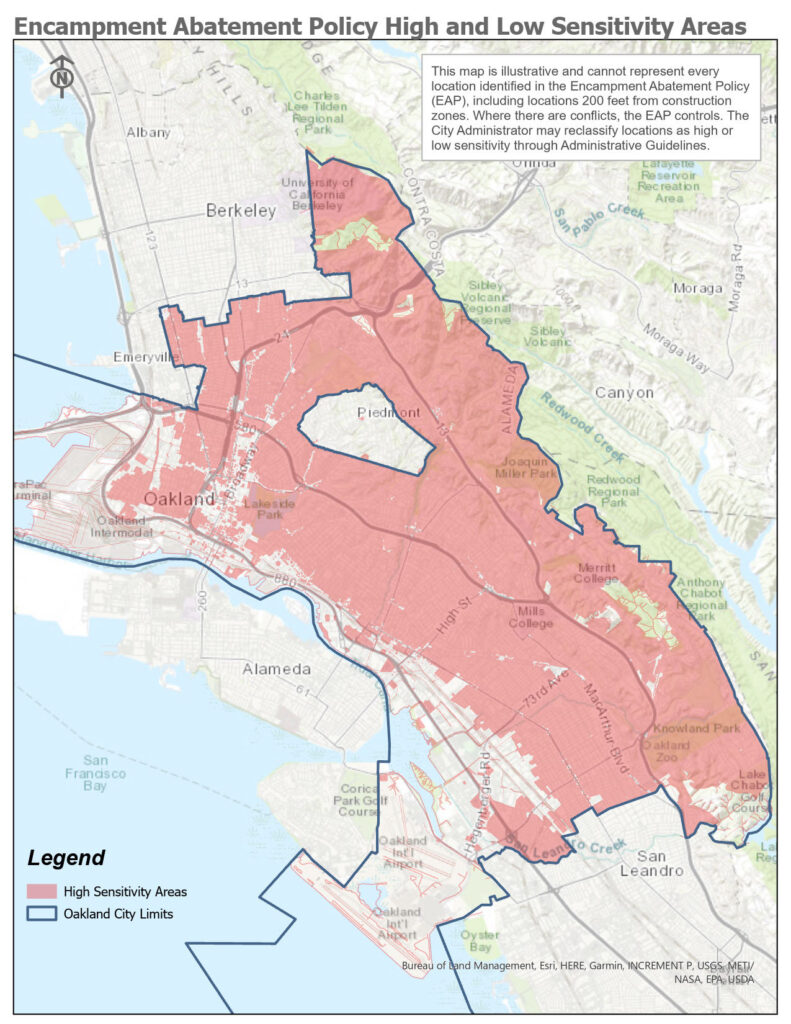
High-sensitivity zones include areas near homes, schools, childcare centers, parks, businesses, hospitals, waterways, transit infrastructure, construction sites, and locations where access is blocked for pedestrians, among others. Encampments in these areas are prioritized for closure.
Low-sensitivity zones consist of other city-owned properties not specifically designated as high-sensitivity. In these areas, encampments may be allowed to remain temporarily if they comply with certain standards, such as maintaining clear access routes, limiting campsite size to 12-by-12 feet, spacing tents or structures to 6 feet apart or more, and avoiding hazardous storage and illegal utility hookups, among other restrictions.
Under Oakland’s previous Encampment Management Policy, high-sensitivity zones encompassed 90 percent of the city, according to Mayor Barbara Lee’s Homelessness Strategic Action Plan. The new Encampment Abatement Policy expands the footprint of these zones—a subject of debate at the April 14 meeting.
“When the entire city is a high-sensitivity zone, it means that we are outlawing homelessness in Oakland. And I just think that’s a fallacy,” said District 3 Councilmember Carroll Fife. “I can’t support legislation that’s going to perpetuate racist policies that affect my people,” she said, noting that a majority of homeless people in Oakland are Black.
During public comment, several West Oakland business owners who came out in support of the policy asked that the council revise the sensitivity map to place their businesses in high-sensitivity zones.
“ We worked hard for these past five years to improve the streetscapes surrounding our restaurant campus by planting trees, building and cleaning sidewalks. We’ve begun to turn the tide on public perceptions of safety,” said Laura Billings, principal at srmERNST Development Partners.
Critics pointed out that the new sensitivity map placed nearly all low-sensitivity zones in East and West Oakland.
“ Look at the 1937 redlining map compared to the one showing low-sensitivity areas,” Oakland resident Birdie Atwater said.
An amendment by Councilmember Unger directed the city administrator to provide the council with a list of locations in all council districts that could be converted to shelters or low-sensitivity zones in the coming months.
Offers of Shelter
The city is no longer required to consistently provide alternative shelter or housing before closing encampments. Instead, it says the city should make “reasonable efforts” to provide referrals to shelter before and during encampment closures.
The policy makes clear that “emergency closures”—when officials determine there is an imminent threat to life, health, safety, or infrastructure—will not be postponed due to a lack of shelter.
Individuals displaced without a shelter offer may relocate to designated low-sensitivity areas and will not face arrest or citation.
This shift follows the U.S. Supreme Court’s 2024 decision in Grants Pass v. Johnson, which said that cities may constitutionally prohibit encampments, even when there is no adequate shelter available.
When Houston released his initial drafts of the EAP last summer, it negated the requirement for the city to offer shelter to encampment residents altogether. Critics pointed out that Oakland has fewer than 1,300 shelter beds for over 5,000 unhoused people, and California’s Interagency Council on Homelessness (Cal ICH) warned that this facet of the policy could jeopardize Oakland’s state funding if it left no alternative locations for unhoused people. Cal ICH gave the policy the green light after Houston added language that said the city should make reasonable efforts to offer shelter.
“ Abatements are not just removals, they are opportunities for outreach. We connect people to shelter services and long-term housing factors. The goal is stability, not displacement,” said Patricia Brooks, who works as chief of staff for Council President Kevin Jenkins and co-authored the Encampment Abatement Policy.
Some public commenters disagreed with this sentiment.
“ Now, the main flaw of this piece of legislation is that there’s no alternative presented. It’s all about, How do you move people out from where they are,” said architect Michael Pyatok, who develops affordable housing in Oakland. “There’s no plan to create [the] 5,000 shelter beds that are gonna be needed to do that. You’ve got more than 5,000 people on the streets. Where are you gonna move them to?”
More Administrative Control
The new EAP significantly increases administrative control over the city’s encampment management tactics. It shifts key decisions from Oakland City Council to the City Administrator and the staff of the city’s designated Encampment Management and Abatement Team (EMAT, adopted in place of the former EMT).
Instead of relying on fixed sensitivity zones and standards established through legislation, the EAP allows administrators to reclassify sensitivity zones and implement new standard operating procedures without returning to the council for each change.
It also gives staff broad discretion to apply detailed health, safety, and infrastructure criteria when determining where closures occur. In practice, this means the EAP can be modified quickly and with less public deliberation.
A Divided Hearing
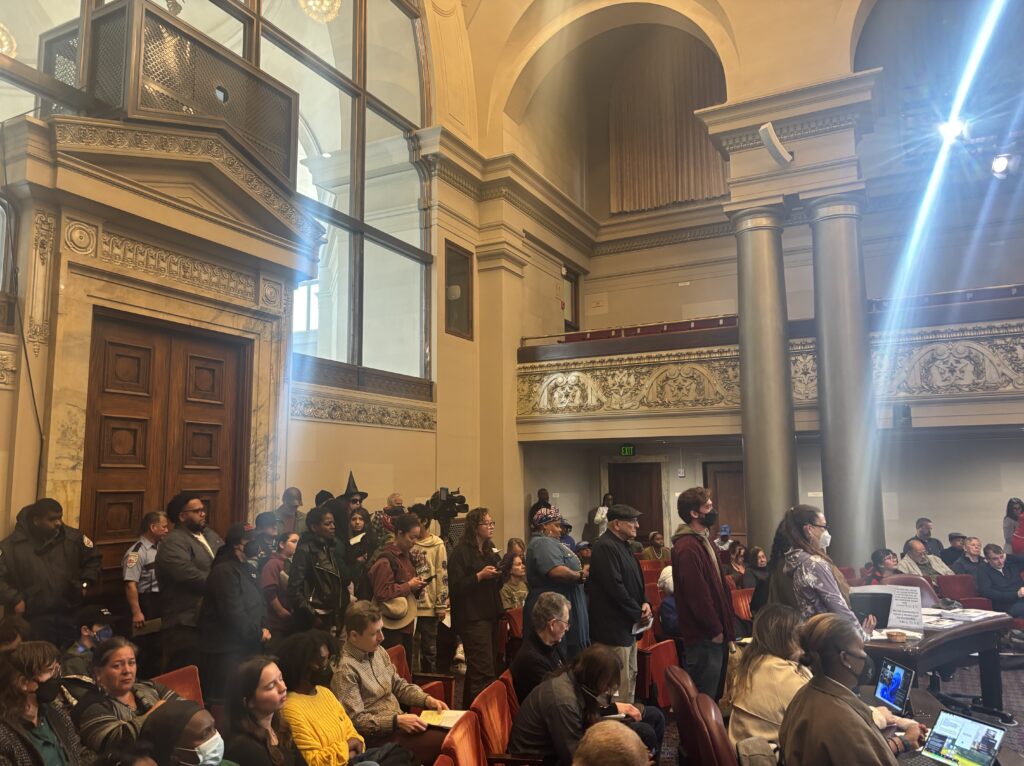
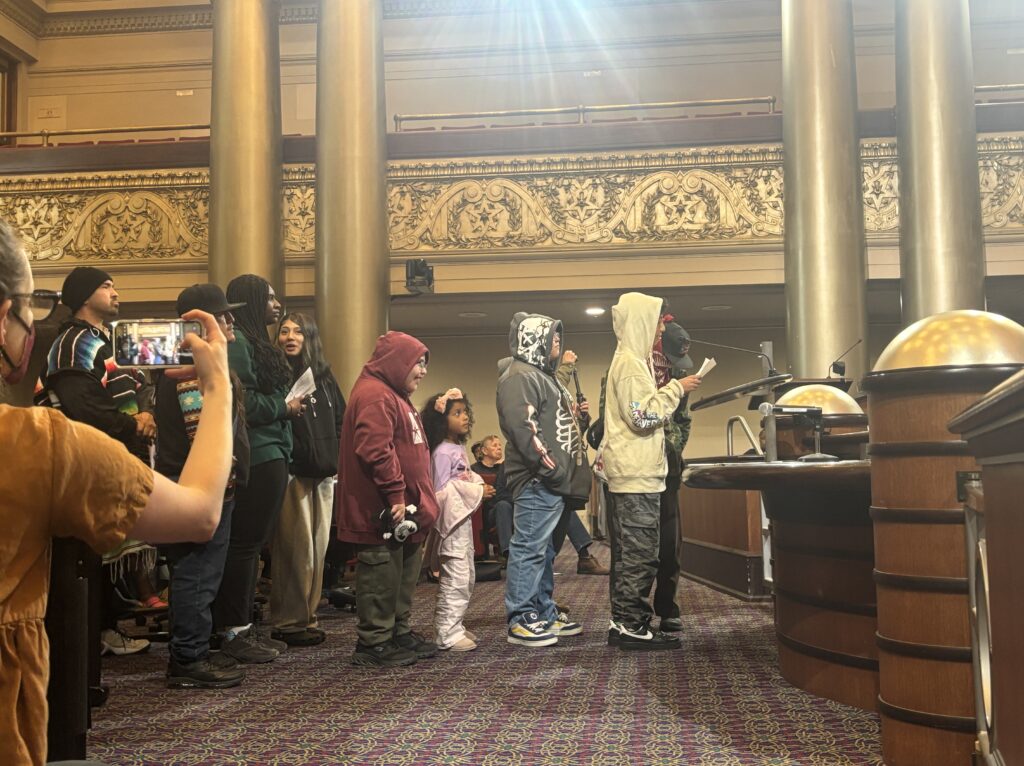
The Encampment Abatement Policy was the only item on the agenda at the April 14 special meeting. In total, 58 people spoke during public comment: 15 supported the EAP and 43 spoke out against it.
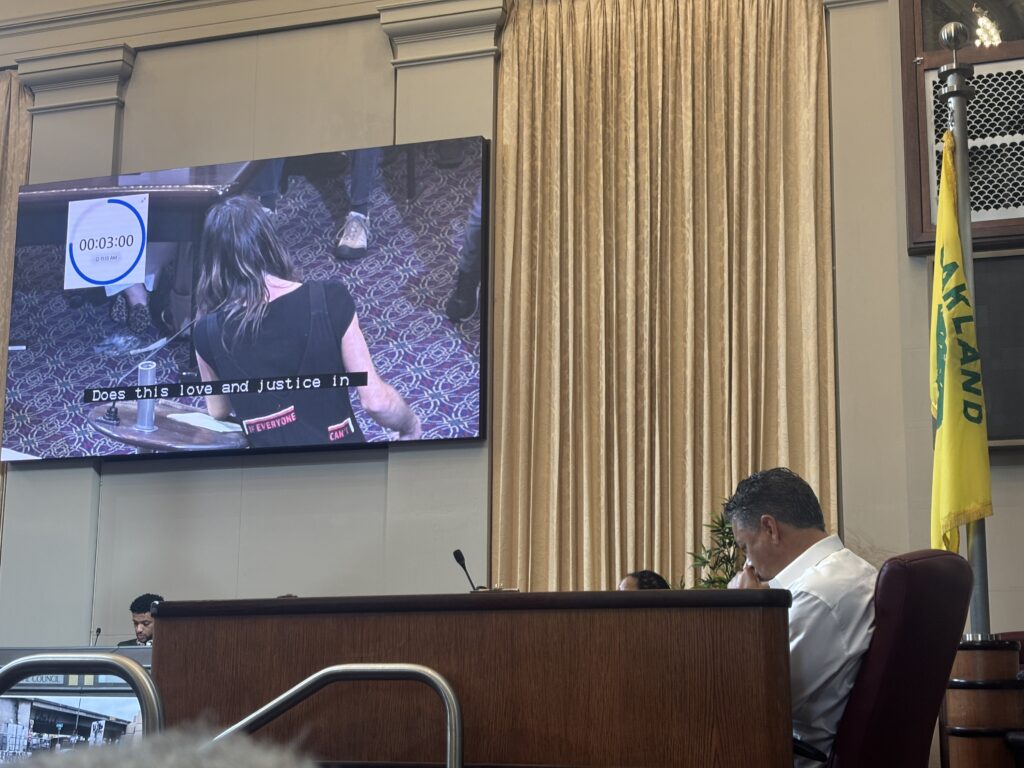
The policy was narrowly approved by the city council in a 5–1 vote. Councilmembers Zac Unger, Charlene Wang, Rowena Brown, and Council President Kevin Jenkins all voted yes after introducing amendments, which were approved. Councilmember Carroll Fife abstained from the vote after providing her own amendments. Councilmember Noel Gallo voted no, and Councilmember Janani Ramachandran was excused.
Councilmember Unger said he voted yes because of the council’s amendments.
“ I had hoped that we as a city could come together around a more comprehensive and strategic vision for addressing homelessness that…really reflected the urgency of the issue. And we haven’t quite achieved that unity,” Unger said. “This encampment management is a small but necessary—unfortunately—piece of the puzzle.”
“ I’m not in support of this policy,” said Councilmember Gallo, who cast the sole no vote. “This city council—we need to deal with what we have in place…be able to deliver a service… Jesus said take care of the needy. Take care of the poor.”
Alastair Boone is the Director of Street Spirit and a beat reporting fellow for KALW covering homelessness.