Sweeps, tows, tickets, violence, displacement, and no support on the street. This was the endless cycle Lisa “Tiny” Gray-Garcia and her mother, Mama Dee, faced as an unhoused family for more than 10 years. In 1996, they decided they’d had enough, and made the decision to create the solutions they needed but were never offered.
“It was dedicated to a vision me and my mom had while we were sleeping in the street, in a doorway in Oakland,” said Gray-Garcia. “We believed we needed to create a community of fellow houseless people, that was not just housing but that was support, community, healing, and love.”
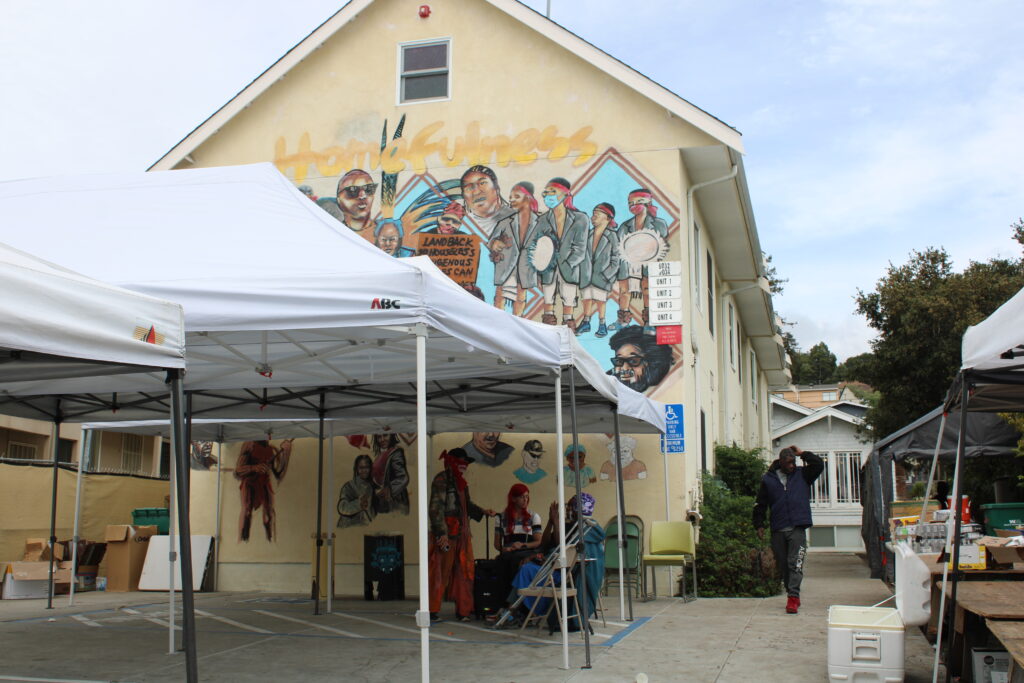
Twenty-nine years later, on MacArthur Avenue in East Oakland, the vision and dream of a mother and daughter is alive and fighting for its community. POOR Magazine and its Homefulness project, which opened in 2020, have successfully built a four-unit rent-free apartment complex, which houses 25 previously unhoused members, a duplex, a classroom, and a radio station. Homefulness is working on building four more rent-free housing sites with construction ongoing for the second site in Oakland, with goals of building additional sites in Los Angeles, San Francisco, and Washington state.
POOR Magazine also provides media, art, and journalism education to community members who’ve experienced poverty or houselessness. Their mission is to provide a healing solution to houselessness through community work and self-sustaining projects that put their community in charge.
Programs include a sliding scale cafe that feeds hundreds of Oakland residents every week, a community newsroom that meets once a month to share the stories of the unhoused, a hotel fund that currently supports 35 unhoused individuals with temporary housing, and the “People’s School” for children living in Homefulness.
During the most recent community newsroom meeting, dressed in black sunglasses, a red bandana over her face, and a bright orange prison uniform under her torn camo jacket, Gray-Garcia urged 20 unhoused or previously unhoused folks to be unashamed and proud of who they were.
“This is a moment of grief, they are sweeping up houseless humans like we are trash,” Gray-Garcia said. “Are we trash? We can build our own solutions, we’re standing in a solution—this is a solution. Poor and houseless people together built these homes, how about that?”
Muteado Silencio, 40, joined POOR Magazine at age 17 after finding inspiration in its grassroots organizing model—led by poor people with first-hand experience with homelessness. He described its members as people who grew up in poverty and continued to fight for their survival.
“With places like public shelters, there’s programs where the people who live there are viewed as clients, and not people taking ownership and leadership,” said Silencio. “Homefulness is the opposite, it’s the residents, families who are leading this movement. Also we take ownership of this dream we call Homefulness.”
Leajay Harper, 42, moved into Homefulness in 2023 after living on the street for 10 years. LeaJay struggled with drug addiction as she and many of her friends received no support in temporary shelters.
“Even though a lot of my friends have been housed in project-based housing, they’ve been scattered and isolated. So some people are even more depressed when they were living outside,” said Harper.
POOR Magazine has provided Harper the chance to escape addiction and reunite with her daughter after being separated for 10 years. Unlike other temporary interim housing programs in the City of Oakland, they both live together now in Homefulness, indefinitely and without a timeline.
POOR Magazine spent $500,000 to build its first Homefulness apartment program, a project that took around 11 years to finish. The funding was sourced from donations and grants they call the “Bank of Community Reparations.” Its members do not go through an application process. They simply become involved as they continue to participate and learn about the program.
“There’s something that happens to our people when they take ownership,” Silencio said, “and can say ‘I built this for myself and for my family.’ Just like the Zapatistas say, when you don’t have something to fight for—which is land or something you built—you won’t fight or stand for anything.”
Angelo Claure is a graduate student at UC Berkeley Journalism and covers homelessness in Oakland.