This interview has been lightly edited for length and clarity.
The first Monday of every month is a busy day at the Street Spirit office—the new issue has just arrived. Street Spirit vendors pack the front room, the smell of fried chicken swirls among tall stacks of freshly bundled newspapers. Vendors grab a plate of hot food and sit down to catch up with one another, sharing the talk around town and other stories from the streets before heading out to sell the newest edition.
The work of selling papers is rooted in community connection, but it’s not often that vendors get a chance to connect with each other. So in September 2024, Street Spirit began hosting a monthly lunch to bring the vendor community under one roof, making a space for vendors new and old to commune with one another.
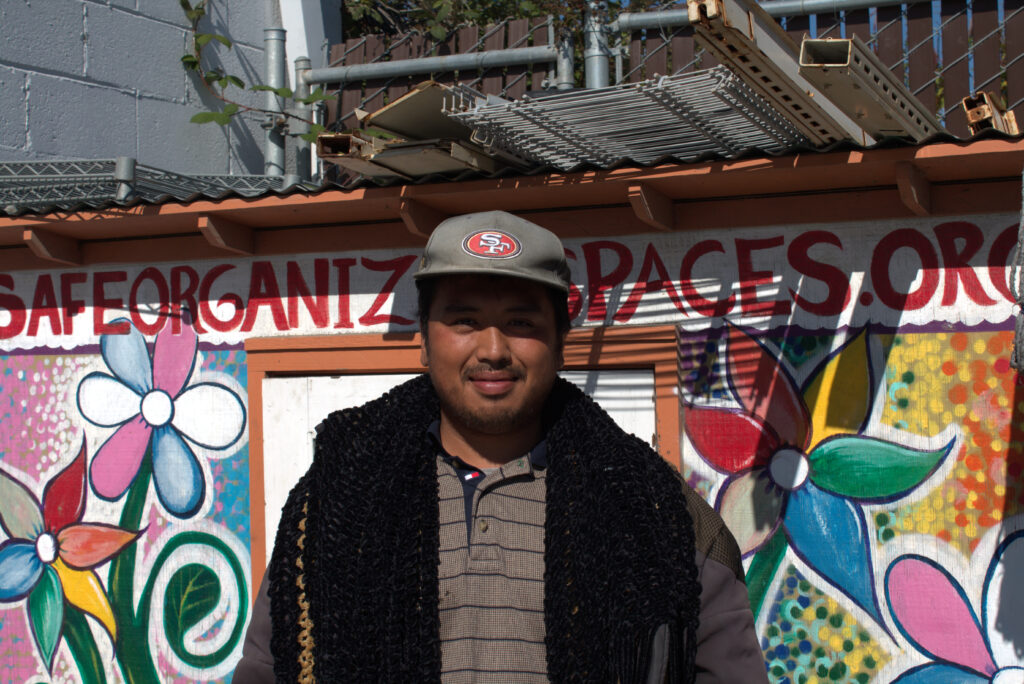
One of Street Spirit’s newest vendors, Taylor Del Rosario, came to his first vendor lunch in November last year, making the 10-mile journey from Richmond to Berkeley on his bike. He had recently signed up as Richmond’s first Street Spirit vendor after learning about the program at Safe Organized Spaces Richmond (SOS), a community hub and resource center in Richmond’s Iron Triangle neighborhood. While he had already been selling papers he picked up at SOS, this was his first time meeting the larger Street Spirit community in person. We sat down with Taylor to learn more about his story before he made his way back to Richmond.
Cole Haddock and Maria Toldi (C&M): How long have you been homeless?
Taylor Del Rosario (TDR): I’ve been homeless since I was 23. I lost my job, and then my parents kicked me out. I found work again during COVID, and then COVID just made everything worse still.
C&M: How old are you now?
TDR: I’m 30.
C&M: How have the past seven years felt for you?
TDR: I don’t know. I’ve been just trying to run away from my problems and societal views. I’d rather be hurt than try to, like, say my situation is better compared to somebody else’s, but [I have my] pride and honor. It took me a long time [to seek services]. I was sleeping outside in the wilderness for like a year, in the Hilltop area. I don’t know. I just needed a break from society for a little bit.
C&M: What was it like growing up in Richmond?
TDR: Man, the poverty was pretty bad back then…in Richmond and surrounding neighborhoods. [There] wasn’t really like, you know, designated places to go other than parks. There wasn’t really much to do other than try to kill time.
There’s only so much a family that lives in poverty can do, you know what I mean? You just can’t really do much. My only real contact with other people was school and [riding my bike]. But I dropped out of school because of an injury. I couldn’t concentrate in school much.
C&M: What happened with your injury?
TDR: I was playing football on concrete, and a bigger kid fell on me and fucked up my shoulder. I had bones sticking out of my shoulder, and my parents didn’t do shit about it for like a month, thinking it’d be, like, okay by itself. But when they were [convinced] by a doctor that I needed an operation, they were like, well, that’s his problem now. I was like 14 and 15 [at the time], I didn’t know how to set up any doctor’s appointments.
I was already having trouble in school…and I ended up dropping out a couple years later because it was just too much to focus.
I was like 21 or 22 when I told my parents, ‘I’ve got to get this. I [need] emergency surgery.’ I couldn’t deal with it anymore. So I got operated on and tried to go back to work. But my parents ended up kicking me out because I wasn’t paying enough rent. So that’s how I started my homeless thing. At 23. I’ve been pretty much homeless since then.
C&M: How did you support yourself when you first became homeless?
TDR: I started noticing I was getting a little bit healthier after some of the surgeries, and then I started doing my bike riding thing in San Francisco, doing Uber Eats for a year. That’s the only translated skill I had. Riding bikes.
C&M: How long have you been biking?
TDR: Since I was six years old. I told my dad I wanted to take off my training wheels on my bike. He took them off and then walked away, and I just rode. Rode right into a car. And I was like, well, that’s what I’m gonna learn now. From now on, people are not really gonna be there for me. So I’m just gonna ride.
When I was a kid I would ride my bike everywhere, no matter how big the hill was. I just kept pedaling. And I never really got tired, because on the way down [the hill], it would just feel the rush and wind. I’d just keep on going at it.
That’s kind of what life meant to me at that moment. You know what I mean? As long as I kept pushing through the downwind, [it would] give me enough boost to keep on going.
C&M: You were a bike courier for a year. Why did you stop?
TDR: I decided I wanted to take a break and look for real work, and signed up to stay at a youth shelter when I was 25. But before I got into the shelter, I got hit by a bus coming back from El Cerrito. It clipped me from behind, and I didn’t know how bad it was until I couldn’t move my leg. I was pretty much disabled and walking around with a cane for about a year.
That’s when I checked into the youth shelter, and I finally got off the cane and crutch. Then I got a job. I was working at Hello Fresh before they shut down, and had an apartment for a year through a housing program. But there was no follow-up [program support], and I fell behind on rent. That was about five years ago, and I’ve been homeless since then—on the streets, in shelters, wandering around.
C&M: Where are you staying now?
TDR: I sleep at the park.
C&M: What do you do with your day?
TDR: You know, just having the energy and the freedom is good for me. I used to go from the Richmond shelter and walk to lunch, and then to Point Richmond to swim in the water. I would do that twice a week. And that was something of an eye opener, because not everybody has the benefit of having a day free. Or having a bed to go to.
C&M: What do you like about Richmond?
TDR: The way we deal with things. It’s like a family. We’re a very bright community. Through all the rough times, there are always people who understand and give back.
C&M: How often do you come to SOS?
TDR: I try to come as often as I can. I find creating communion in these spaces that they allow us is important.
C&M: What do you like about SOS?
TDR: It’s the people and the history. I know the history because I’m from here. The people here are working on themselves, and they work a lot with the community, trying to do the best for everybody.
C&M: What’s your bike route to the Street Spirit office?
TDR: Well, that’s purely intuition. I know Berkeley from the time I spent growing up over here. I was going down University, and I was like, I bet it’s right down here next to this school across the street. I said I was gonna come, and I try to do things timely for everybody’s benefit. Like, if I could do it in a timely manner, I will.
C&M: Why do you think people should read Street Spirit?
TDR: Of course, they have the connections and the stuff you want to read from the headlines, but also, a newspaper could have an extra page on it where it’s something super meaningful to you or somebody else. Just reading somebody’s story should be an eye opener, because that’s somebody’s life. I’m happy that people can express themselves.
C&M: Have you encountered any struggles while selling Street Spirit?
TDR: I have to use a lot of energy talking to people, which is good on my part. I felt like all the good things you put out definitely come back. It’s good for me—it’s human nature to talk. Like animals need breathing. It’s always a healthy interaction. But you know, maybe if I was more esteemed as a salesman, or had some kind of sign to put up. That’s something I could improve on.
C&M: If you could envision the next three years of your life, what do you hope for yourself?
TDR: I envision myself working a little bit more. It’s good to be busy. I have friends that are way older and don’t really have anything, and they still just want a purpose. When you ain’t got nothing, people just wanna be given benefit of the doubt. Some people can’t give themselves that self-esteem. I’m not ready to doubt somebody else as long as they’re trying.
C&M: Do you have any advice for other Street Spirit vendors?
TDR: If you’re faithful to yourself, you don’t give up on a single thing. That’s the most human advice I could give somebody. Then the smartest advice is: you never know what you could get from just being there.
Cole Haddock and Maria Toldi are recent graduates of UC Berkeley. They are currently working on an investigative mapping report of encampment sweeps in the Bay Area.