
Bueno.
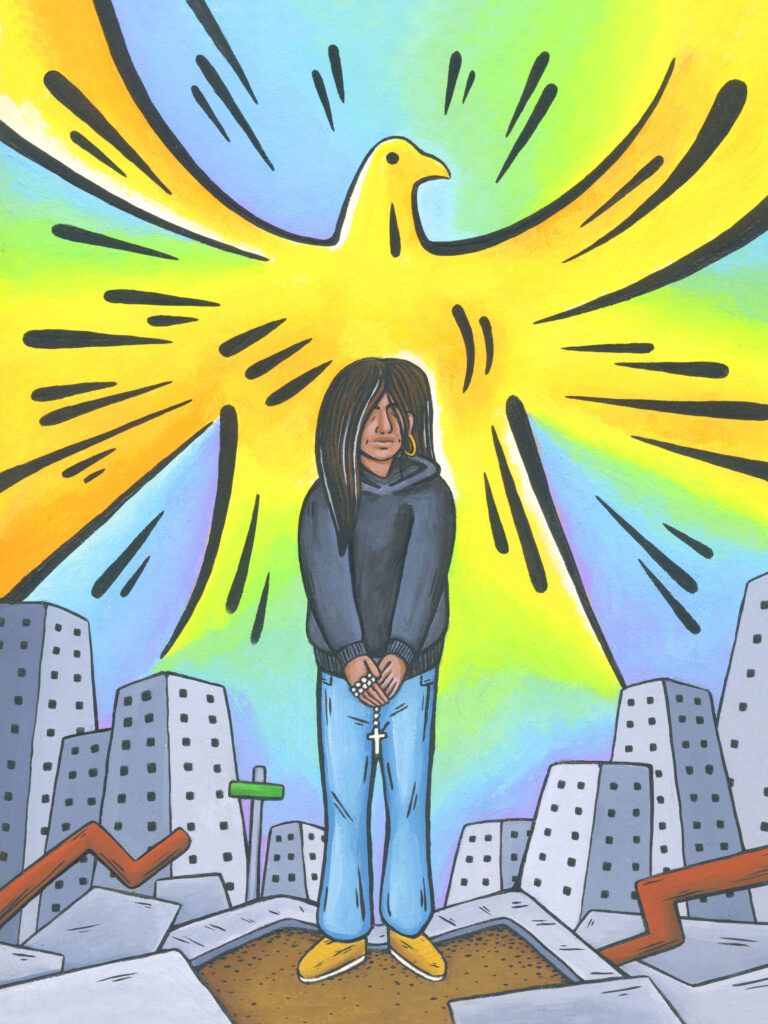
Yo soy de México, del estado de Puebla. Soy una mujer mexicana, cien por ciento guerrera. Me costó mucho venir a los Estados Unidos con la ilusión del sueño americano. Tengo seis años ahorita acá. No es tan fácil como lo dicen. Una cosa es vivirla y la otra es como la cuenta.
Aquí se me viene más que a trabajar. Si no trabaja, no hay nada. Solo obedecer a los patrones. Muchas veces vendiendo flores, muchas veces vendiendo fruta, vendiendo tamales, limpiando en un lugar que te pueden aceptar sin un documento. Cuando nunca lo has hecho, ni en tu casa, pero aquí lo vienes a hacer.
Aquí no eres nada. Aquí no hay títulos. Aquí somos barrenderos, cocineros, jardineros y lo que caiga.
Hay gente muy mala pero también hay gente buena. Como todo. Este país—a uno le roba todo—todo es un sueño, todas sus cositas que haga, hasta sus ahorros. Al grado que lo dejan hecho un homeless en la calle.
Ahora mis amistades sufren en la calle. La gente a veces nos humillan por no saber su lengua. Y sufrimos discriminación por la policía. Ellos no quieren a las personas como uno que ande en la calle, que ande vagando.
Pagamos justos por pecadores. A algunos nos gusta trabajar, no nos gusta robar. Buscar trabajo es mucho. Porque no hay papeles. Piden muchas cosas. Es de verdad una suerte encontrarlo. A veces no hay trabajo y tienen que buscar el modo para sobrevivir, de un modo o de otro.
Yo no los juzgo. Solo Dios sabe.
Además cuando los compañeros están en campamentos, la policía llega, nos tiran todo, los golpean, los jalan, se los llevan. Otros corren—se salvan y luchan por su vida.
Yo quisiera ayudar también, pero no puedo con lo mío. Yo como todo—hay que buscar a veces en donde se puede habitar—debajo de un puente, abajo de una coladera, una casa abandonada, en terreno, en campo—donde puede uno pasar la noche sin peligro.
Andamos peligrando más las mujeres. Con tanta discriminación, con tantos problemas que hay en la calle, con tanta drogadicción, con tanto alcoholismo. Yo no puedo decir nada de mis compañeros, porque a lo mejor yo también lo he hecho y he pasado por ahí por aguantar una noche el hambre, la sed y el frío.
Estuve ahí bien alegre, contenta viendo a mis nietos. La felicidad es mi familia, mis amistades que quiero alrededor.
Y acá en Estados Unidos, se está más solo que allá.
Todo el sueño americano es mentira. Eso. Me destroza. Es mentira. No lo hagan. Lo único que a veces les digo a mis paisanos: no se vengan. Aquí,—no vemos más a nuestras familias.
Pero aquí estoy. Y voy a seguir adelante. Yo aquí he sufrido, pero voy a lograr lo que yo quiero. Porque yo quiero ese sueño y yo lo voy a hacer. Porque yo nunca me he doblado.
Soy guerrera y voy a seguir así. Me enseñaron mis tierras, mis tierras mexicanas. Son aguiluchos y son personas de fuerza, son guerreros de verdad. Nunca doblamos las manos ni las rodillas. Seguimos adelante. Y cuando damos la mano, la damos de corazón. Sin pedir nada a cambio.
Y le pido tanto a Dios por todos. Que ya no haya tanta discriminación para la gente de la calle. Y que a mis homeless no les pase nada.
Siempre voy a ser noble. Yo creo que tengo un corazón de pollo, así me decía mi madre. Y voy a continuar. Voy a seguir y voy a seguir escribiendo mi historia. Porque es real. Todo esto que les hablo es real. Yo vine de un lugar donde venía yo muy mal, muy golpeada, muy lastimada. Y acá estoy, aquí sigo en el sueño gabacho con los compañeros.
Y lo voy a lograr. Lo voy a lograr.
Gracias.
Atentamente,
María.
English translation of “El Sueño Gabacho”
Bueno.
I’m from Mexico, from the state of Puebla. I am a Mexican woman, one hundred percent guerrera. It cost me a lot to come to the United States. I came with the hope of the American dream. I’ve been here for six years now. It’s not as easy as they say it is. One thing is what they say, and another is to actually live it.
Here, you come only to work. If you don’t work, there’s nothing. Obey the bosses. I’ve spent a lot of time selling flowers, selling fruit, selling tamales, cleaning in any place that accepts me without papers. Here you end up doing whatever you can—even if you’ve never done it before, not even in your own house.
Here you are nothing. We have no titles here. Here we are recyclers, cooks, gardeners, construction workers—whatever falls to us.
There are very bad people but there are also good people. Just like everywhere. This country will steal everything from you—all those dreams, all the little things you do, all of your savings. In the end, they still leave the homeless in the streets.
My friends and companions—we suffer in the streets. People humiliate us for not knowing their language. We suffer discrimination from the police because they don’t want people like us walking in the street, walking homeless.
We all pay for a few sinners. Most of us like to work, we don’t like to steal. To look for work is a lot. Because there are no papers. They ask for a lot of things. It really is a blessing to find work. Sometimes, there is no work, and they have to look for a way to survive, one way or another.
I do not judge them. Only God knows.
When we’re in the encampments, [the police] arrive, throw everything at us, and beat some of us. They shove people, they arrest people. Other people run—they save themselves and fight for their lives.
I’d like to help, but I can’t even handle my own. I am like everyone else. I have to look where I can—under a bridge, in a sewer, in an abandoned building, in parks—anywhere I can live, where I can spend the night safely.
Women are in greater danger. With so much discrimination, so many problems on the streets, so much drug addiction, so much alcoholism. I can’t say anything about them because maybe I’ve been there too. I’ve been through it all just to not endure hunger, thirst, and cold for a night.
I used to be happy, very happy. I was content to be with my grandchildren. Happiness is my family and my friends around me.
But here in the United States, you are more alone than there.
The whole American dream is a lie. That’s it. It’s devastating. It’s a lie. Don’t do it. The only thing I tell friends: Don’t come. Here—we don’t see our families anymore.
But here I am. And I am going to continue forward. I’ve suffered here, but I’m going to achieve what I want. Because I want that dream, and I’m going to do it. Because I’ve never turned back.
I’m a guerrera, and I am going to continue, as I was taught by my land, by Mexico. We are eagles and we are people of strength. We are guerreros. We never bend the knee. We move forward. And when we offer a hand, we offer it from the heart, without asking for anything in return.
And I pray to God for everyone. I pray there’s no more discrimination against people on the street. Pray that nothing happens to my homeless people.
I will always be noble. And I will continue. I will continue writing my story. Because it’s real. I came from a place where I was in very bad shape, very beaten, very hurt. And here I am. Here I am still living el sueño gabacho with my community.
And I will succeed. I will succeed.
Gracias.
Atentamente,
María
As told to Cole Haddock
Translation by Cole Haddock and Maria Toldi
Mi nombre es María, soy una persona sencilla, de un nivel de clase media, muy educada. Depende de cómo me traten. Me gusta protagonizar y escribir la realidad a ver si se oye.