
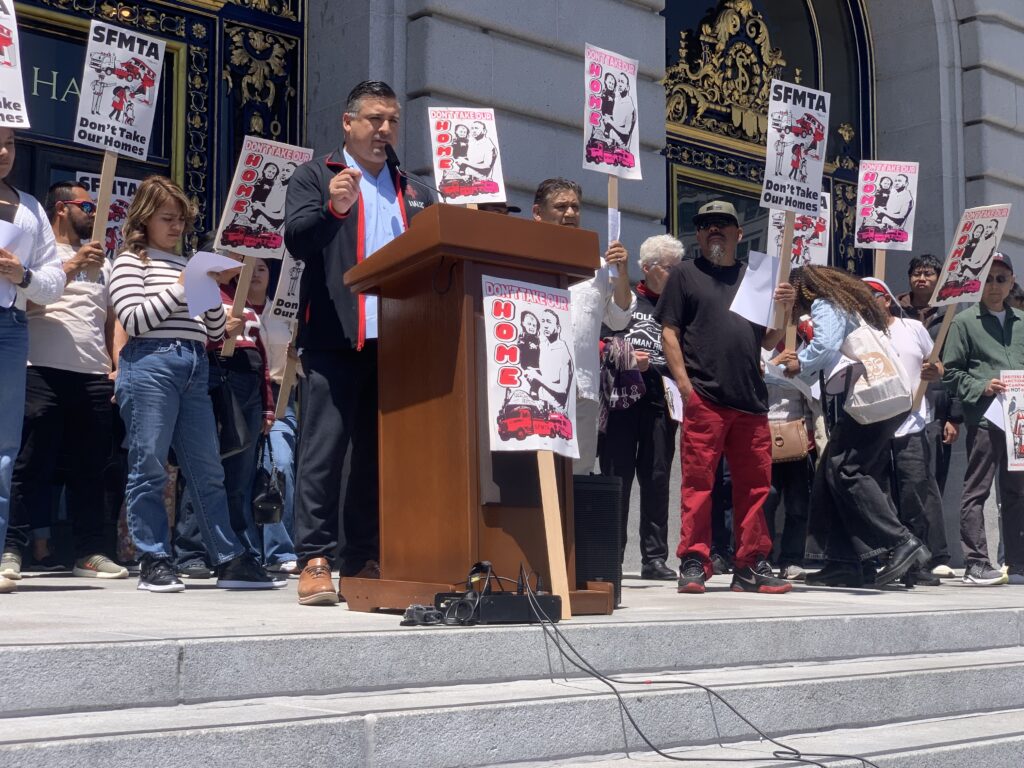
On July 22, less than a year after London Breed attempted to restrict oversized vehicles from parking overnight on certain city streets, San Francisco Mayor Daniel Lurie’s plan to effectively ban recreational vehicles (RVs) citywide passed its final 9-2 vote at the Board of Supervisors.
The legislation has been broken into two parts: a two-hour parking restriction for large vehicles and a “Large Vehicle Refuge Permit” program that would exempt RV households from the two-hour ban for six months. In short, the legislation pairs “the carrot” of paltry shelter and housing offers with the mighty “stick,” a stringent two-hour parking ban that will further criminalize homelessness in the streets of San Francisco.
The refuge permit will temporarily exempt vehicles from the two-hour ban while the city conducts a six-month service outreach operation, in which RV residents will be offered shelter or housing. Households without a permit, including RV residents who reject service offers or violate nebulous “good neighbor policies,” will be subject to the two-hour ban. According to statements from the Office of the Mayor, unpermitted vehicles found in violation of the ban will be subject to citation and towing.
While the city frames its proposed refuge permit as a comprehensive protection that will help RV residents transition into long-term solutions, the city’s ultimate goal is to remove all RVs from city streets. The plan allocates $1.5 million for towing expenses over the next two fiscal years, which is projected to cover the costs incurred for removing 350 RVs.
The Mayor’s plan also includes $525,000 for a vehicle buyback program. At a rebate of $175 per linear foot, households with a 22-foot RV will be offered an estimated $3,850 for their vehicle—many of which were purchased for upwards of $10,000. But the slated buyback allocation is vastly underbudgeted. Based on these calculations, less than 150 RVs would be offered a buyback, leaving over 300 households out of luck.
But not all vehicle residents will receive a refuge permit, let alone service offers. With a severely limited housing and shelter inventory, and the concern that RV residents outside of San Francisco would flock to the city with an announcement of shelter and housing offers, the Mayor’s Office has limited permit eligibility to 437 RV households recorded in a count by SFPD in May.
Any RV that is not reflected in the city’s database will immediately face the two-hour restriction.
The Office of the Mayor and the Department of Homelessness and Supportive Housing maintain that RV households will be issued “appropriate offers” of shelter or housing, but the Mayor’s budget—which will soon be approved by the Board of Supervisors—slates only 65 housing subsidies specific to families living in RVs. With an estimated 120–140 families living in RVs, the city’s proposed allotment means less than half of those families will receive subsidies.
The rest of the nearly 400 San Franciscans living in RVs will be offered non-congregate “interim housing,” the city’s new term for shelter. While non-congregate shelter provides a private room, the programs include carceral restrictions such as curfews, unannounced searches or “cleanings,” and bans on pets, outside food, and visitors.
Another hurdle that the city must overcome is its shrinking non-congregate shelter portfolio. With the slated closure of two Geary Street shelter sites—the Adante and the Monarch—at the end of this year, the city’s current count of 560 non-congregate shelter units will plummet, bringing into question whether the city will have enough shelter to house the newly permitted RV residents. Moreover, there are currently 454 single adults on the city’s shelter waiting list, not including those affected by new parking restrictions.
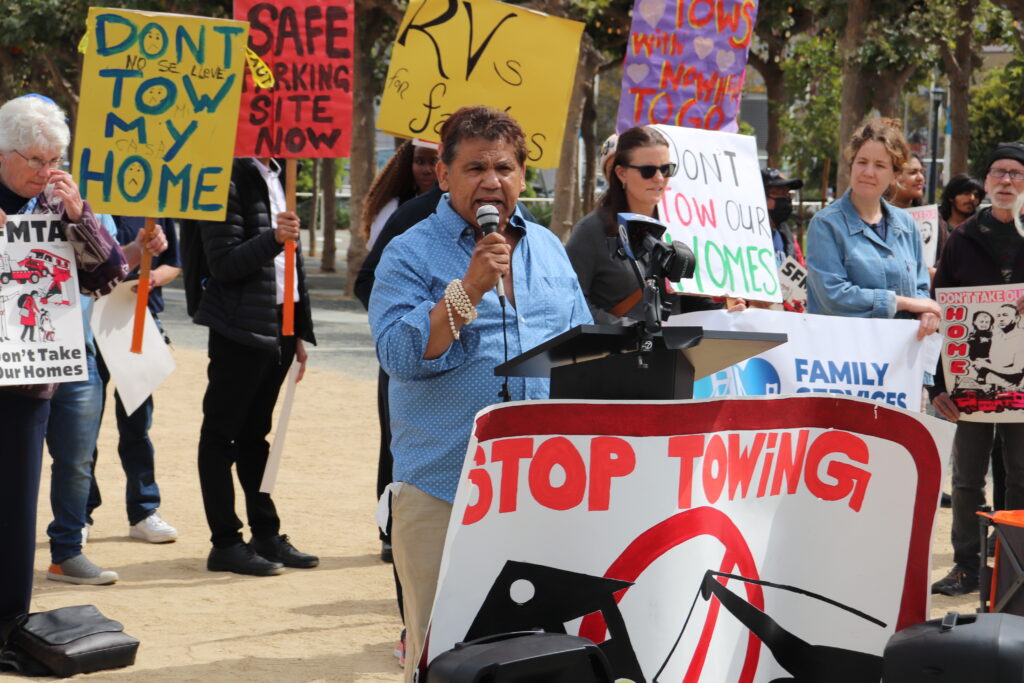
In June, vehicle residents and their advocates organized protests against the proposed RV ban, stating that the plan’s shelter provisions do not meet the needs of those who will be displaced from their vehicular homes. In response to the protests, the city defended its shelter and housing inventory, citing an additional 600 subsidies and hotel vouchers for both families and single adults.
But this system-wide tally is practically irrelevant. San Francisco’s method of assessing unhoused folks for placement in the city’s limited housing stock—a process called “Coordinated Entry”—largely deprioritizes vehicularly housed people.
Coordinated Entry grants housing offers to people with the greatest levels of acuity, which are often street-homeless folks. Vehicle residents, who are often able to find greater stability with the privacy and protection offered by their RVs, are subsequently denied housing offers. In other words, vehicle residents will continue to compete with all other unhoused San Franciscans and face improbable odds at securing housing placements—all while facing an impending expiration of their “refuge permits” and, in time, a two-hour ban on their homes.
Most importantly, many vehicle residents are undocumented, Spanish-speaking immigrants, both family and single adults alike. As the federal government kidnaps and violently deports undocumented community members, Lurie wants to further destabilize the lives of immigrant families by threatening their homes and limited financial assets. With an outreach strategy that heavily relies on cooperation with SFPD, how should anyone be expected to differentiate a municipal cop from a federal agent at the door of their RV, or—based on a recent investigation into SFPD’s collaboration with ICE—trust that service acceptance will actually result in shelter placement, and not incarceration in one of the Trump regime’s detention camps?
On its face, this plan is ill-conceived. It skimps on the necessary time, budgetary considerations, and available infrastructure to achieve its stated goal of providing long-term housing to vehicularly housed people. But Lurie’s plan is draconian at its core. The implication of a two-hour time limit on RV parking criminalizes the fastest growing contingent of homeless people in San Francisco: the vehicularly housed. This effort stems directly from the Lurie administration’s continued capitulation to vocally anti-homeless neighbors who demand a scrubbing of visualized homelessness without any care for the treatment of homeless people themselves, nor the inventory of resources the city has to offer them.
Proven solutions, like safe parking sites and RV parks—both of which were recommended by the Benioff Homelessness and Housing Initiative’s 2022 vehicular homelessness study in Oakland—have not only been ignored, but outright resisted by the city. San Francisco’s only safe parking site, a parking program that offers on-site wraparound services and case management, closed 10 months early in March 2025.
The city may posture itself in support of immigrants and other vulnerable members of our communities, but San Francisco’s continued ignorance toward research-backed solutions, and in pursuit of increased policing and criminalization, will not forge a path out of this crisis.
Lukas Illa is a human rights organizer at the Coalition on Homelessness in San Francisco.