

Ken Houston has become an incendiary figure on the Oakland City Council for his approach to homelessness. He co-authored the city’s new Encampment Abatement Policy, which makes it easier for officials to tow RVs and close encampments across the city without always offering shelter. Houston backs up his approach to homelessness by pointing to his experience as the founder and head of a nonprofit called the Beautification Council, which received $4.5 million in contracts with the City of Oakland between 2020 and 2025 to empower unhoused people by hiring them to clean up the city.
But public records and interviews with people who worked for Houston’s nonprofit in recent years tell a more complicated story, in which Houston repeatedly pushed unhoused people out of East Oakland neighborhoods while working to clean up areas where they lived.
Interviews with five unhoused people who interacted with Houston when he was at the Beautification Council paint a picture of Houston using his perceived authority to intimidate them into relocating outside of the city’s standard procedure for encampment closures. Most requested anonymity for fear of retaliation.
“If you get on the wrong side of him, he’ll come after you…like fucking with your camper and where you live,” one unhoused Oakland resident told Street Spirit.
“He is doing some of the things that he’s supposed to do…He has porta-potties brought out and washers brought out to the encampments,” the person continued. “But he’s also utilizing some of the rules and regulations to benefit [himself] and his company.”
In text messages with Street Spirit, Houston denied these allegations, saying that his work at the Beautification Council did not exceed the boundaries of their contracts. In an earlier interview, he said that he continues to take homelessness seriously as a councilmember.
“I have electoral obligations,” Houston told Street Spirit. “I swore to protect my people from foreign or domestic enemies. Do you know how serious that is? I take that serious. I take it just as serious as being sworn into a gang.”
Cleanup or crackdown?
Houston said he officially stepped away from his work with the Beautification Council shortly before taking office in January 2025, and that the organization does not currently have any contracts with the City of Oakland. But homelessness has been a key point of Houston’s work as a councilmember.
Last year, he co-authored the Encampment Abatement Policy, a controversial rewrite of the city’s current encampment policy that would shrink the geographic area where unsheltered people can reside. The proposed policy would also crack down on people who live in vehicles by writing them out of the city’s definition of “encampment” altogether. Its first drafts sought to make it easier for the city to close encampments without offering shelter to their residents. The latest version of the proposal is scheduled for a vote at a special meeting of the Oakland City Council on April 14.
According to the people who spoke to Street Spirit, some of the tenets of this proposed policy—such as closing encampments on an emergency basis without notice and cracking down on RVs—were common practices of the Beautification Council.
At the start of the COVID-19 pandemic, the City of Oakland said it would pause encampment closures in accordance with CDC guidance, turning their attention to installing portable toilets, handwashing stations, and providing garbage services. In support of that mission, the city also started awarding contracts to nonprofits that promised to help people on the street. The city gave the Beautification Council a $175,000 contract to “micro clean and sanitize homeless encampments in order to minimize the spread of Covid-19.”

As the Executive Director, Ken Houston was paid $195 an hour, according to city contracts. The labor was performed by eight “Homeless/Hard to employ” people for a stipend payment of $17.19 an hour.
Oakland continued working with the Beautification Council the following year, awarding the organization an additional $1.6 million no-bid contract in May 2021 to “gather and bag debris and litter in and around homeless encampments.” The contract was amended to $2.8 million in 2022.
Six invoices submitted to the city by the Beautification Council between March 8 and April 24, 2021 say that their work included more than deep cleaning: Beautification Council was also “relocating homeless encampments from city or public property located cityside.”
And in a progress report emailed to the city in June 2021, Houston wrote: “Note; the relocation of the encampment for safety reasons during the cleaning and securing will also take place.” A series of photos shows a person dismantling the tent that they lived in.

In the accompanying progress report, he made a note about one encampment in particular, in a parking lot on 66th Avenue in East Oakland.
“Note; the homeless encampment on the city property at 796 66th ave was relocated with options & dignity,” Houston wrote in the email to the city.
The City of Oakland turned that lot into a safe RV parking site the following year.
Oakland’s Encampment Management Policy outlines clear rules for when and how encampments can be closed, and if residents are required to move. It says that city officials must give residents advance notice of a closure, properly store their belongings, and offer shelter and other resources before clearing a site. The regulations also designate a group of city employees called the Encampment Management Team (EMT) as those responsible for carrying out all encampment operations, including everything from cleanups to closures. The policy requires members of the EMT to follow specific notice and storage requirements in order to ensure that the legal rights of encampment residents are upheld. It is not clear from the record or witness statements whether the Beautification Council followed these policies.
The City of Oakland says their work with the Beautification Council complied with the policy.
“The Encampment Management team worked in partnership with the Beautification Council to close and clean encampments, including the site at 66th Ave,” Oakland Public Information Officer Jean Walsh said in an email. “Beautification Council staff would follow on the heels of Oakland’s encampment management teams to clean up smaller debris. This helped ensure City crews could focus their energy on getting the larger items off more sites more quickly,” she continued.
Houston says the same.
“We have never done sweeps,” he told Street Spirit by text message, referring to encampment closures. “We only did cleanups after the city relocated scheduled encampment closures for deep cleanings.”
However, according to the city’s “Completed Encampment Management Team Operations” dataset, there were no scheduled cleanings or closures on 66th Avenue in 2021.
The City of Oakland did not respond to further questions by press time. We will update this article with any response.

Unhoused Oaklanders who spoke to Street Spirit say that the Beautification Council was doing more than simply following on the heels of the city—particularly in the East Oakland neighborhood where its offices are located.
The Beautification Council’s offices are in a neighborhood known as the Hegenberger Corridor near the Oakland Coliseum. Some unhoused people who lived in that neighborhood in 2023 and 2024 chose the area because of the selection of convenience stores, gas stations, and fast food joints along Hegenberger, allowing them to easily buy necessities or find the occasional odd job. They appreciated Collins Drive—a cul-de-sac off the main road—because it offered a quiet respite from the traffic. The Beautification Council’s offices are located at the end of the block.
An unhoused person we’re calling Quinn on the condition of anonymity says they first encountered Houston on Collins Drive sometime around 2023, when he pulled behind their vehicle and started taking photos. Quinn, feeling indignant, started to take their own photos.
On another occasion not long after, Quinn says that they parked across the street from the Beautification Council’s offices to eat lunch. Someone knocked on their window and told them to leave.
“I said, ‘Do you own the street?’ He said, ‘No,’” Quinn recalls.
Quinn waited it out. Soon, police officers arrived and ordered them leave, despite Quinn insisting that they were not illegally parked. Quinn later came to recognize the man who knocked on their window as one of Houston’s hired workers.
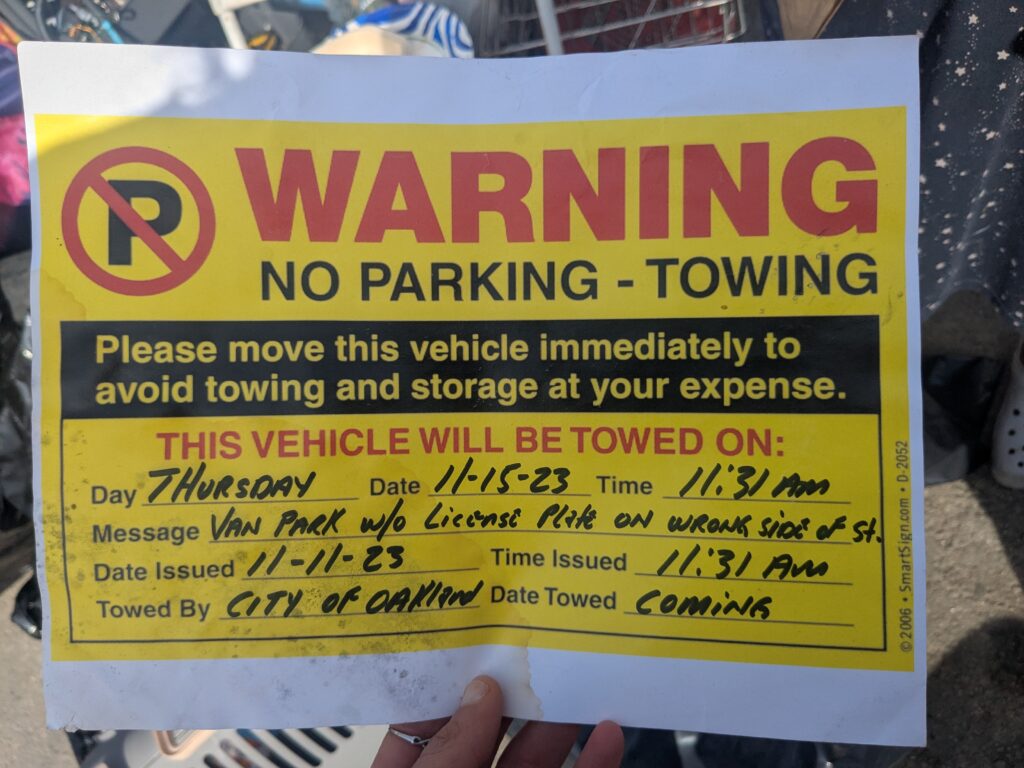
That same year, a sign was placed on Quinn’s van stating that it would be towed by the “City of Oakland.” Oakland officials who reviewed a photo of the sign said that is not a legitimate city notice.
“We do not source warning stickers through SmartSign.com,” city spokesperson Kent Bravo told Street Spirit, referring to the sign’s manufacturer.
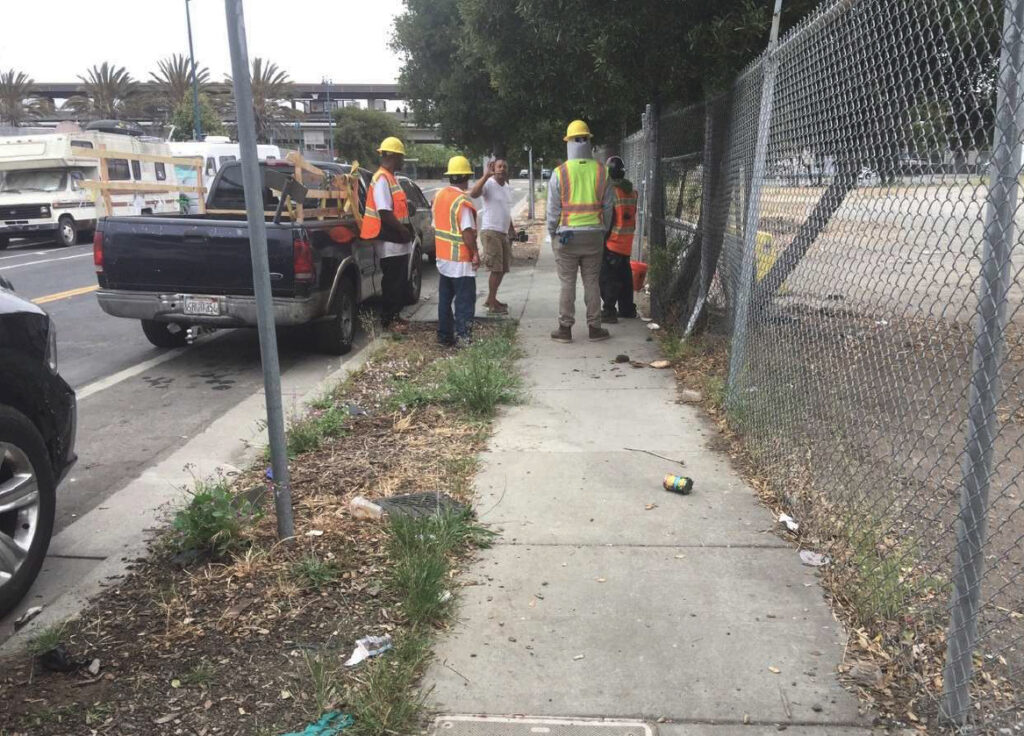
Quinn and two other people who camped near Collins Drive in 2023 and 2024 also told Street Spirit that they eventually found concrete blocks placed around their live-in vehicles.
One person said that Houston told them personally that he placed the blocks there at the direction of the fire department.
“He had the people who worked for him move those bricks [using forklifts] to block us off from the sidewalk,” said another person, forcing them to park elsewhere.
Houston denies these allegations. “We have never put any concrete blocks to block the sidewalks,” he said.
City records show that on at least one occasion, the Beautification Council did partner with the city to place concrete barriers on the streets of Oakland. According to payment history documents obtained by Street Spirit from 2024, Beautification Council submitted a $15,400 invoice to the city’s Economic & Workforce Development Department for the “Delivery, Place & Set of 28 Concrete Blocks at 3 city locations.”
After this story was published, the City of Oakland said, “the Economic & Workforce Development Department contracted with the Beautification Council to install concrete barriers at the entrance to City-owned property, but not in the right of way, ie on streets or sidewalks.”
On television, Houston praised the use of concrete blocks as a deterrent for encampments. In a 2024 interview with CBS News Bay Area, he complained about an encampment near his office building and mentioned blocks that kept people away.
“Look what’s right there,” Houston told CBS, pointing to RVs down the street from his office. “The only reason why it’s not down here is because of the positive activity we have out here and the blocks that were placed here to stop them from blocking and parking on the sidewalk.”
He did not say in the clip who placed the blocks there.
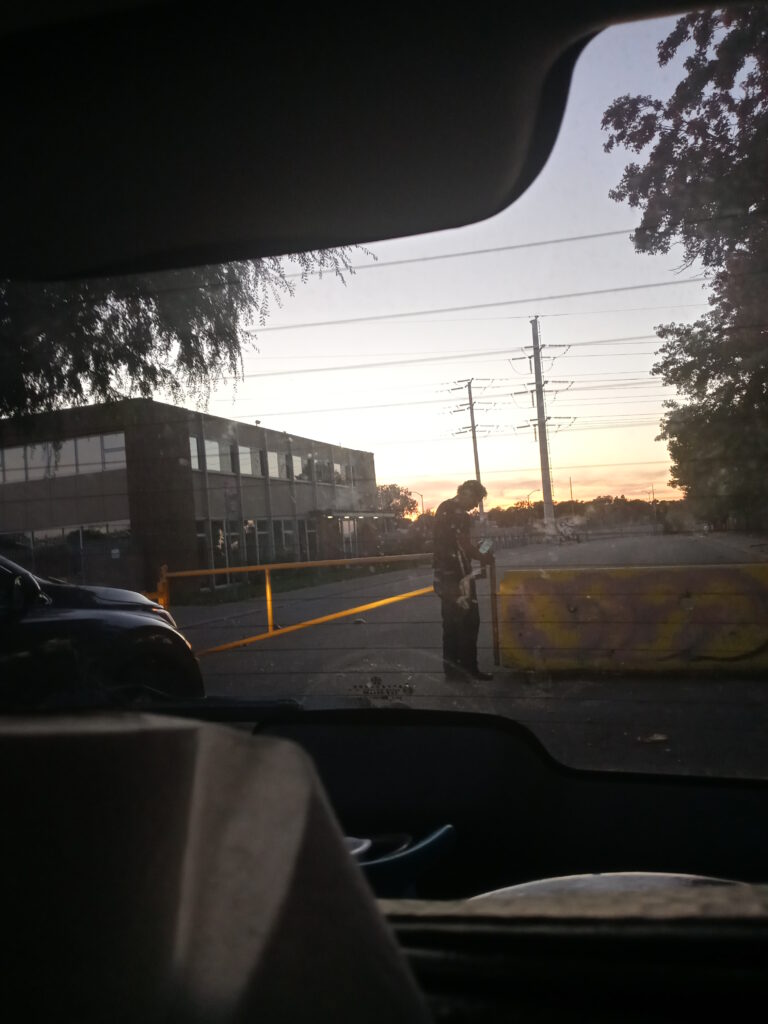
Eventually, a concrete construction barrier and a gate appeared in the middle of Collins Drive, keeping outside vehicles from getting too close to the Beautification Council office building.
Promises vs. Pay
The Beautification Council’s contracts said they would hire unhoused and justice-impacted people in order to “economically stabilize and empower” them.
People who have worked with the Beautification Council describe feeling misled about how many hours of work they would get with the organization—and how they would be paid.
One former worker said that after a month of working at the Beautification Council, he was paid with a $25 Safeway gift card.
In a text message, Houston wrote that the Beautication Council “have never in their 10+ years ever used or gave away Safeway cards,” but did not respond to further questions.
Two other unhoused people who have worked for the Beautification Council said they were paid around $25 an hour through prepaid debit cards, and that the hours were unpredictable. One of the people was grateful for the work, while the other said they felt angry with Houston because they had hoped it would turn into more regular work.
Street Spirit reached out to the Beautification Council asking to shadow the organization’s day-to-day operations. Houston initially offered to help arrange interviews with city hall staffers who have worked with the Beautification Council, but later rescinded the offer. The organization’s current director ultimately declined to be interviewed or shadowed.
Politics of Enforcement
Houston says that his approach homelessness is one of the things that got him elected.
“There’s a couple of people who might roll by and say, ‘Fuck Ken. Fuck you, man. You made me move my truck.’ I got that,” he told Street Spirit. “You can’t make everybody happy. But the majority of the people that pull by, Black, White, Chinese, speaking in all different dialects, say ‘Thank you, thank you. Somebody is hearing us. Somebody is us. You are us.’ And I am.“
But for the unhoused individuals that spoke to Street Spirit, Houston’s approach to homelessness has long seemed to blur the lines of his authority, and feels incongruous with his stated goals of helping unhoused people.
One of the people who camped near Houston’s offices in 2023 and 2024 now lives in an encampment in another part of town. They remember learning about the Beautification Council’s work helping unhoused people at the same time that they felt unwelcome in Houston’s neighborhood.
“He must be really selective,” they remember thinking.
Editor’s Note: A previous version of this story was published on Street Spirit‘s website in April 2026.
Amy Martyn is a freelance journalist based in the Bay Area who has also written for Wired Magazine, NBC, and Business Insider. Read her last article about people languishing for years in San Francisco’s jails here.