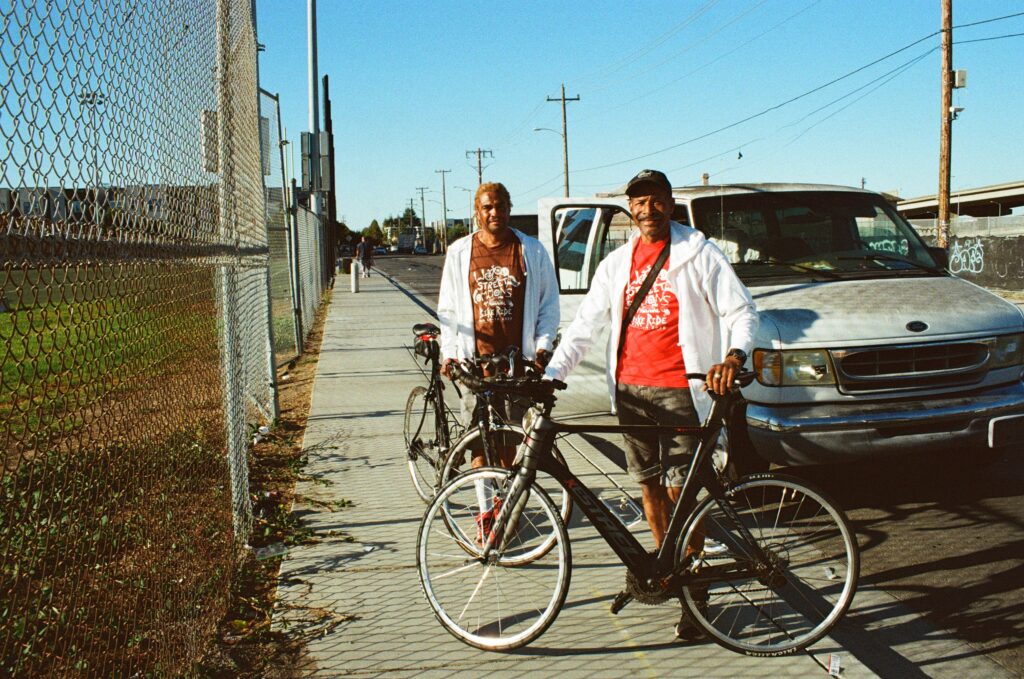
Every October for the past four years, a group of Oakland-based advocates known as the Wood Street Commons have used bikes to bring attention to their common goal: finding solutions to homelessness.
Departing from 1707 Wood Street in West Oakland—the site of the former encampment where many of them once lived—the convoy of riders and support vehicles sets out on a three-day journey to Sacramento with planned stops in public spaces, encampments, and eventually the halls of the State Capitol. The ultimate goal is to advocate for their inclusion in decision-making around the homelessness crisis, but the act of riding itself serves a larger symbolic purpose: unhoused people are normal people, and just like normal people, they love riding bikes.
For unhoused community members in Oakland, bicycles are a vital component of day-to-day life, a practical tool that helps sustain the often fractured relationship of encampment life and our larger urban ecosystem. Without a personal vehicle, transportation options for unhoused Oaklanders are limited to costly and unpredictable public transit systems, or at a snail’s pace with their two feet against the pavement.
Access to a bicycle, in contrast, could be the difference in making it to an appointment on time, gathering groceries and supplies miles away from the encampment, or visiting friends who live on the other end of town—all of which could be accomplished in one afternoon, rather than exhaustively spread out over the course of days.
John Janosko, an organizer and member of Wood Street Commons, learned just how effective bike transportation can be after losing his housing at the age of 44. While he remembers riding his Sears-branded bike through the streets of Berkeley as a young teenager, it wasn’t until he became homeless that cycling served a purpose beyond recreation—it was a daily necessity, a tool to stay connected to his community, a regenerative practice that helped maintain both his physical and mental health.
“I started riding bikes to get around, to do what I was doing,” Janosko said, “Before that, I used to just walk everywhere. But I also noticed it was helping me stay in shape, because, you know, at the time I was doing things that weren’t too great for my body. But it just became a lifestyle. I couldn’t stop doing it, honestly. It was a way to get around town, a way to stay healthy, to stay in community…it was something we all had in common.”
That “we” includes one of Janosko’s closest friends, LaMonté Ford. The two first met in 2012, just months before Janosko lost his housing, and they’ve been navigating homelessness in the streets of Oakland ever since—first on a small strip Caltrans-owned land behind Mosswood Park, later as residents of the Wood Street encampment, and now as organizers and outreach workers with Wood Street Commons.
Ford knows bikes as well as he knows Oakland, where he has lived his entire life. What began as a form of escape from the flatlands in the 1980s and 90s, Ford’s relationship to cycling has taken on many forms over the years: a necessary form of travel, a subterranean enterprise, but more importantly, a mode of physical and spiritual rehabilitation.
“When I was younger, it was like a getaway,” Ford said, “a chance to feel like an adult. We used to go up in packs into the Oakland hills and ride down as fast as we possibly could.”
On one of those occasions, at the age of 14, Ford’s Mongoose caught a puncture in its rear tire on a descent down Snake Road, a steep and sinuous two-lane street in the hills above Montclair. Without a patch kit in his pocket, Ford made a split decision to remove the tire and continue his plunge down the unforgiving grade, riding all the way back to West Oakland on a bare metal rim.
“I was with my friends, and had my baby brother with me,” Ford said, “I couldn’t stop, I had to keep going. So I rode all the way down the hill, sparks flying up behind me.”
As he grew older, Ford’s thrill for cycling continued to burn into the cracks of Oakland’s asphalt, which soon developed into a street-wise lifestyle that proved to be as competitive as it could be lucrative.
“I used it for sport,” Ford said, “I’d race people for a couple of bucks. But as I became an adult, it was this thing we did
to get money. We used to go out and steal people’s bikes.”
Bike theft in the Bay Area is a harsh and detestable reality, inciting anger and anxiety among cyclists who depend on bikes for work, sport, or play. Regardless of their material worth, the invaluable relationships people build with their bikes also carry an unnerving risk—they may disappear within seconds, and often sight unseen.
Ford does not shy away from the truth of these transgressions, and readily admits to the emotional dissonance that was necessary to both excuse and enable his bikenapping.
“I was deep in my addiction at the time,” he said, “and thought I was committing a lesser crime—that it really wouldn’t affect anyone. It was an ‘it’s only a bicycle’ kind of mindset. But then God intervened.”
That intervention took place one afternoon in an Oakland park, a few hundred feet from where Ford had just stolen a bike from a neighboring yard. As Ford tells it, after breaking the bike from its lock, God led him into the nearby park that was soon teeming with Oakland police. As cops spread out through the field, Ford realized he wasn’t their suspect, but because of his own crime, couldn’t move on until they did. He sat down in the grass with the hope he’d make it out clean, carefully watching the house he had just trespassed.
“I see this big, giant dude come out of the house,” Ford said, “he’s dangling his keys and walking to where I had just stolen the bike. He stops and looks around, and just starts screaming and hollering. He falls down on his belly and is crying real crocodile tears, and I mean big, giant crocodile tears. That’s when I realized he wasn’t an adult. He was 14.”
Ford’s attention then turned to screams coming from inside the house, an argument between the teenager’s parents filtering out from its windows. Memories flooded in as Ford watched over this scene, including moments in childhood when his own bike was essential for making an escape.
“I understand the need to get away sometimes, you know?” Ford said, “I started crying. I was like, ‘oh man, fuck, I have to give him his bike.’ So I rolled it over to him, and I promised that young man I would never steal a bike again. And I haven’t.”
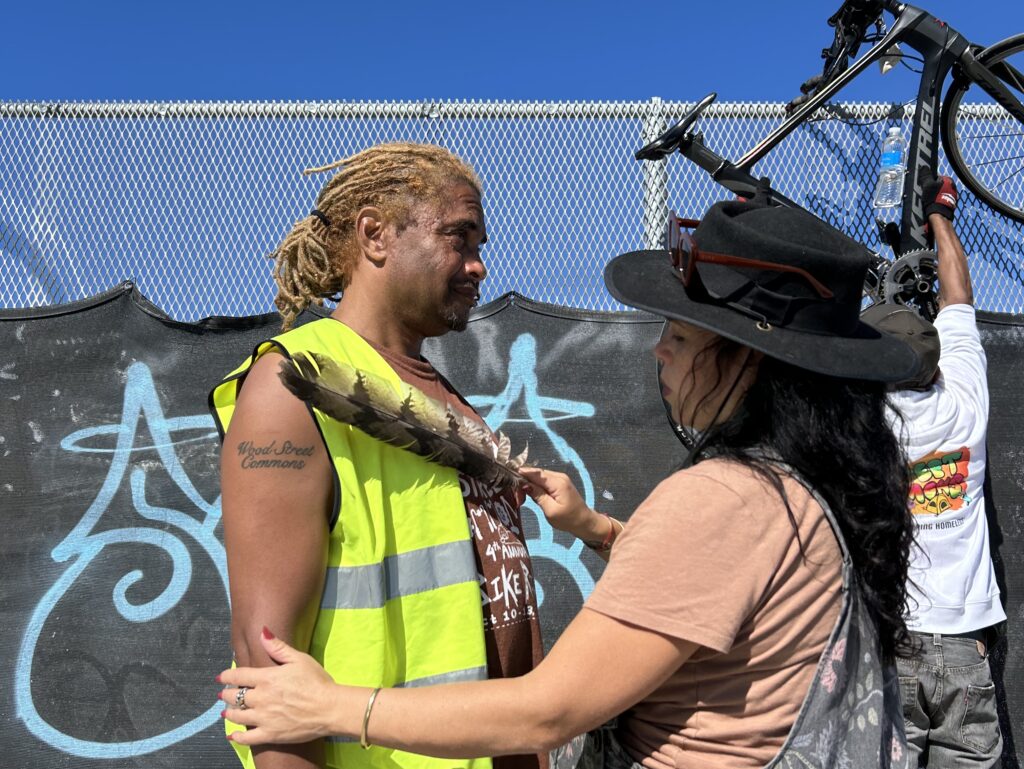
Janosko and Ford are no strangers to the darker sides of street life, and openly speak to their past struggles with a confidence and poise that can only be earned through years of experience and self-reflection. But at the core of this growth and rehabilitation over the past few years, deeper commonalities have remained integral to their momentum as friends and individuals—a commitment to homeless advocacy and the shared joy of cycling.
“Biking is almost like a ritual,” Janosko said, “We don’t have limitations because of bikes. They’ve allowed us to be free.”
During a stint in jail in 2019, Janosko and his “street dad,” Tone, were discussing how they’d like to do things differently once they were free. Inspired by a recent run-in with a lone, unhoused traveler who had cycled into Oakland by way of Seattle, Janosko came up with the idea of a cross-country homeless advocacy bike tour from the Bay Area to New York City.
“The idea,” Janosko said, “was to inform the nation that all homeless people aren’t a certain way, to spread the word of who we really are. We’d ride all the way to New York, stop in different cities, and just sit and talk to people. We wanted to bring positive attention to our communities, but hadn’t figured out how to do that just yet…then all of that attention came to Wood Street.”
After their release in November that year, Janosko and Tone moved to a parcel of land that was quickly becoming a refuge for Oakland’s growing unhoused community—1707 Wood Street. Ford and other friends had recently relocated there after years in Mosswood Park, and as COVID-19 emptied city streets the following spring, many more moved to the vacant lot in search of food, shelter, and community.
LeaJay Harper is one of Wood Street’s original residents, first moving there in 2013. Like Janosko, Harper’s relationship to cycling developed out of necessity once she became unhoused, often to collect recycling and other supplies around town.
“I couldn’t afford a bike trailer, so I’d grab a couple shopping carts and tie them to the back of my bike,” Harper said, “or I would ghost ride a cart with the other hand on my handlebars. I didn’t like morning traffic, so me and my dog would go out at night. Through Emeryville and up to Berkeley…then Adeline all the way back down to Wood Street.”
Harper’s nightly routine had been in motion for years, but soon melded with the efforts of other Wood Street residents looking out for one another through the pandemic. Through 2020–21, as the city pumped the brakes on both encampment services and evictions, their community began organizing to form what they called “The Commons,” a practice that emphasized resource sharing, built trust among residents and advocates, and eventually made its way to the headlines.
Public attention turned to Wood Street when the pandemic was at its peak. From the construction of cob houses complete with composting toilets, rogue and fiery punk shows, and its unquestionable growth in size, their community became a focal point for an evolving discourse on homelessness. State officials began to take notice, and in summer 2022, Caltrans announced that they would begin eviction operations on state-owned sections of the property, displacing hundreds of its residents in the process.
Janosko was still living on the adjacent city-owned lot at 1707 Wood Street when Caltrans evictions began, which reignited his urge to organize an advocacy bike tour. But rather than planning a months-long journey across the United States, Janosko reached out to the Sacramento Homeless Union who were also facing scrutiny for conditions endured throughout COVID-19.
The vision soon began to take shape. Settling on his birthday weekend in early October, Janosko planned a 100-mile route from Wood Street to North Sacramento where another self-governed homeless encampment was beginning to take shape on a vacant parcel of land. The team of riders—which had assembled as the “the Wood Street Commons”—would also spend time at the State Capitol during their visit, requesting sit-down meetings with the offices of state senator Nancy Skinner and then-assemblymember Rob Bonta. The theme of the ride was solidarity—not just with their contacts in Sacramento, but with unhoused communities everywhere.
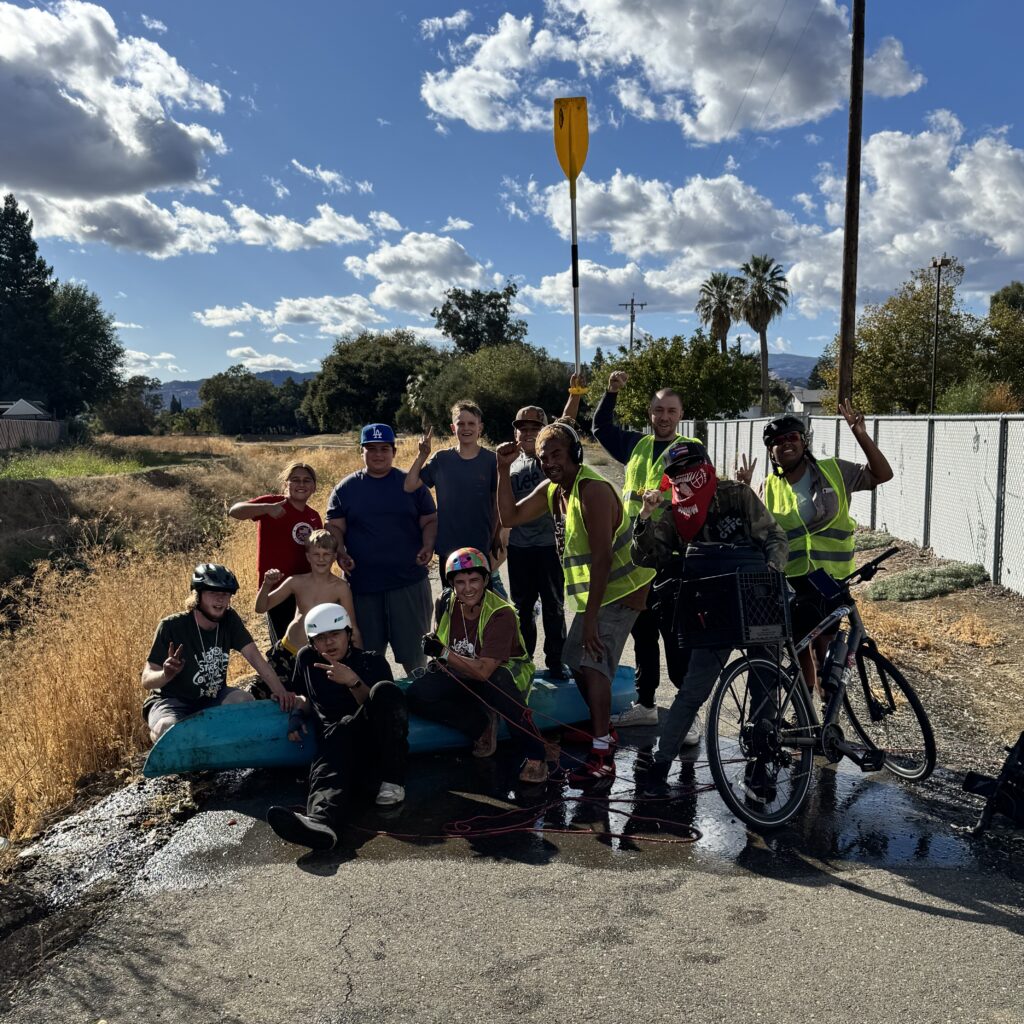
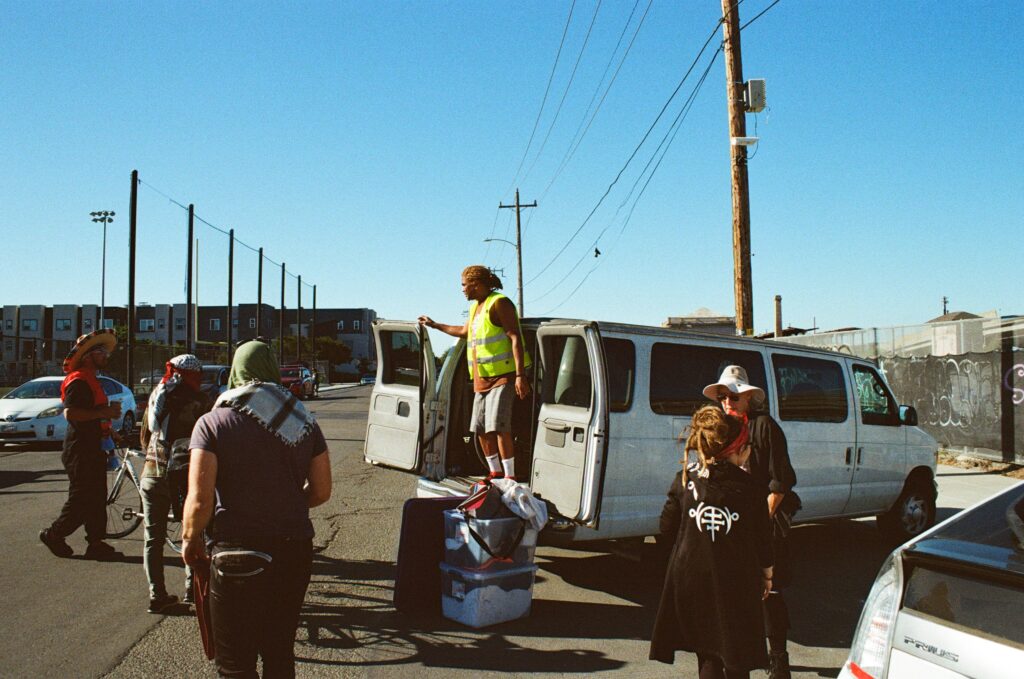
Departing from West Oakland on September 28, the team of approximately 15 riders and support car drivers—including Janosko, Ford, and Harper—made their way up the East Bay shoreline toward the delta, then onward through the Central Valley. Planned stops and overnight camping locations were scheduled along the route to ensure riders stuck together, with support cars driving ahead to set up meals, hydration stations, and tents.
The Sacramento-bound caravan arrived at their destination on the evening of October 1, which couldn’t have been more timely. While the City of Sacramento had surveyed the lot as a potential encampment relocation site earlier that year, some unhoused residents decided to occupy the city-owned property on their own under the banner of “Camp Resolution,” stressing their community’s ability to support and govern themselves. The move was quickly deemed unsafe by city officials and eviction of the site was imminent. It was in the midst of these tensions that Wood Street Commons cut into town on their bikes.
“The city had paved this lot for them,” Harper said, “but then didn’t let them move in. But when we got to Sacramento, they had broken the locks on the gates. They had tents set up for us, dinner prepared for us, it was like a whole thing. Then the next morning police arrived, there were so many of us that they just backed away and left it alone.”
Wood Street Commons took this experience with them as they headed to the Capitol the following Monday, stressing with state officials that the City of Sacramento should follow through with plans to allocate the land as a sanctioned encampment. Their words didn’t fall on deaf ears, and residents of Camp Resolution would soon approach Sacramento officials themselves. A month later, after dozens of Camp Resolution residents spoke during a heated Sacramento City Council meeting, the city decided to lease the property to Safe Ground Sacramento, a deal that was signed in March 2023.
Back in Oakland, Janosko, Ford, and Harper continued their work as organizers, filing Wood Street Commons as a nonprofit organization in February 2023. Recent Caltrans sweeps had already displaced a majority of Wood Street residents, and the City of Oakland would be closing what remained of the encampment in April. By the end of that weeks-long operation, the long-standing community was dispersed into a handful of interim shelter sites, city-sanctioned parking lots, or back to the sidewalks and streets.
The Wood Street Commons team was hit hard by the evictions, each of them forced to seek refuge on their own for the first time in years. Janosko accepted interim shelter at the new Wood Street Community Cabins, Harper moved to a sanctioned RV lot on 66th Avenue, and Ford decidedly set out on his own, fundraising enough money to purchase an RV and park it on the streets of West Oakland. But throughout their struggles to secure housing since the closure in 2023, the three friends have continued conducting street outreach and organizing advocacy programs as Wood Street Commons, including the annual solidarity bike ride from Oakland to Sacramento.
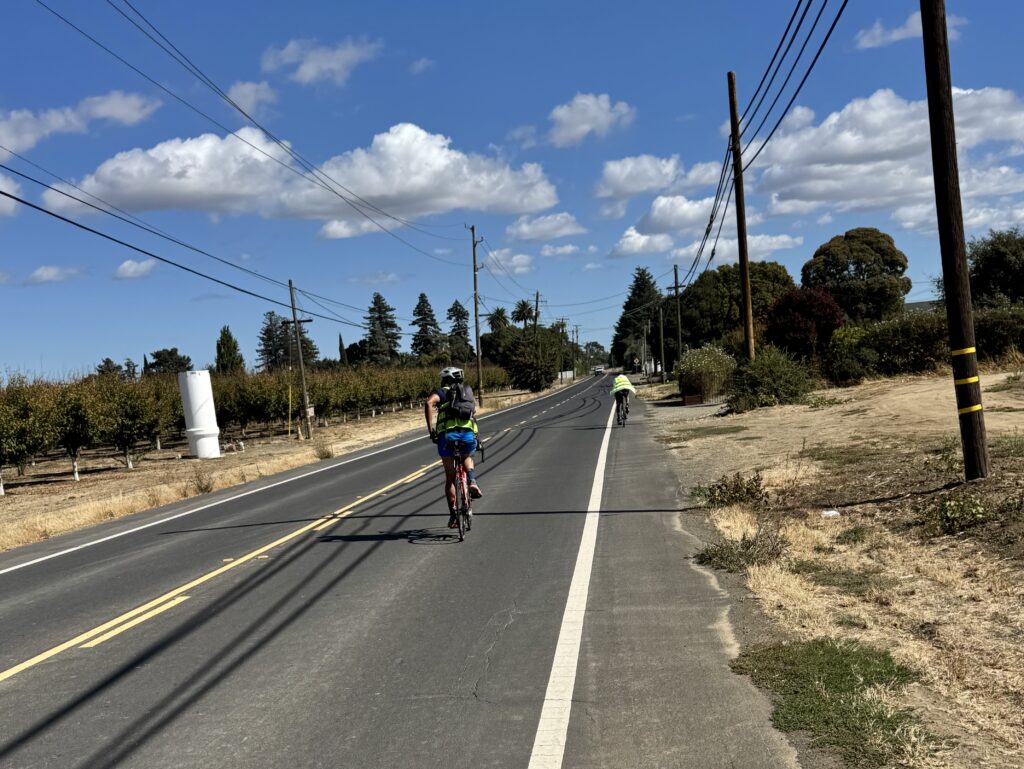
Street Spirit joined Day 1 of the ride this year, setting out from 1707 Wood Street on October 10 with stops in Albany, Richmond, Pinole, and Vallejo. Attendance has nearly doubled since the ride’s inaugural year—from 15 to 30 participants—with a growing team of community advocates and bike enthusiasts offering their skills, resources, and camaraderie throughout the three-day dash to Sacramento.
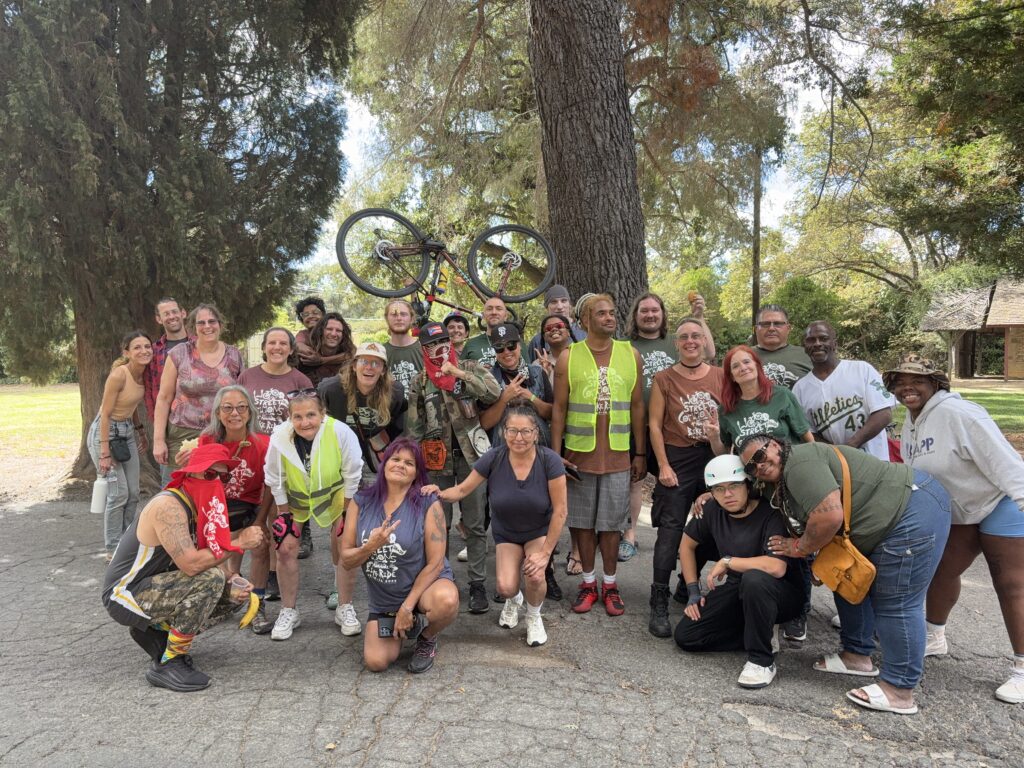
For Janosko, the ride instills a profound sense of hope. Organizing a large bike tour is no easy task, but as he sets out each year from the site of his former home, he’s reminded that the Wood Street community has only grown stronger after years of eviction and displacement.
“It’s overwhelming, honestly,” Janosko said, “it accomplishes something that the average person wouldn’t expect…that people swept from an encampment would still be around. Most encampments are swept and they’re gone…but we’re still here, we’re still doing this. And next year is our fifth annual ride. It just proves to us, over and over again, that we can do anything.”
Janosko, Ford, and Harper have all secured permanent housing within the past two years, providing a level of stability that only bolsters their work with Wood Street Commons. But they emphasize that their advocacy began long before they held house keys, and those experiences in the streets should be the guiding light on the road to ending homelessness.
“We were doing this shit when we were still out there living on Wood Street,” Harper said, “We’re more than capable, and we’ve been saying this the entire time…our outreach, our resource fair, the bike ride…we’re not just talking out the side of our ass, we have real solutions.”
For Ford, the heart of those solutions are rooted in relationships—the formation of “The Commons” down at 1707 Wood Street that continues to sustain his work, his health, and his life.
“We’re all Wood Street,” Ford said, “even the people that weren’t unhoused, they became Wood Street. And for me, Wood Street saved my life. I went there to commit suicide. Instead I watched this organic family accrue. And I’m a part of that family. The ride allows us to all get together again, it’s like a big family reunion.”
Riding on the roads to Sacramento, Ford still appreciates the moments he finds himself alone, just the rider and machine locked in steady unison as he searches for momentum and balance.
“[During the ride], we start as a group, but end up alone at times. Those are my meditation times, the times I go inside myself…to heal myself, to learn myself. To learn who I am as I ride.”
Bradley Penner is the Editor and Lead Reporter of Street Spirit.