Measure W was back in the headlines this summer—but what exactly is it, and what will it do?
If you haven’t been following along, Alameda County voters passed the 10-year half-cent sales tax back in 2020 to generate funds for homelessness services. The funds have been held up in court for nearly five years as the county fought a legal battle with the Alameda County Taxpayers Association. A judge decided in favor of the county earlier this year, which means the $810 million that has accrued since 2021 is now available.
In July, the Alameda County Board of Supervisors decided what to do with the funding generated by the measure: 80 percent of the money—projected to be over $1.4 billion in total—will go to homelessness solutions including prevention, interim housing, permanent housing, and supportive services. The remaining 20 percent will support essential county services, such as food assistance, mental health services, immigrant support, senior services, and more.
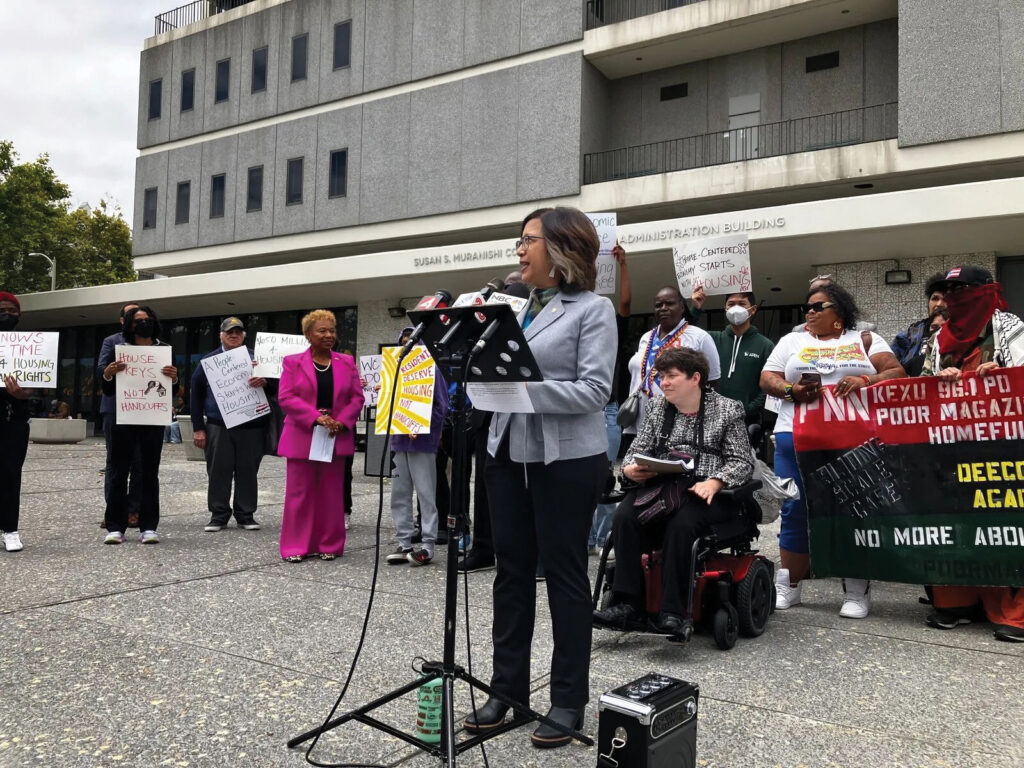
During months of heated debate about how the county should spend the revenue, District 5 Supervisor Nikki Fortunato Bas was a vocal advocate for making sure a majority of funds went to homeless services and prevention. Her office held regular town halls and press conferences with other elected officials and community groups to rally support.
We sat down with the Supervisor to talk about this new funding: What it means, how it will be spent, and whether the county has plans to involve unhoused people themselves in the decision-making process. Our conversation has been lightly edited and condensed.
Street Spirit (SS): So what’s the big deal about the majority of the Measure W funds going to homeless services? Why was this so important to you?
Nikki Fortunato Bas (NFB): With the federal administration threatening our social safety net, this particular year as we are able to start spending Measure W funds, our budget is really threatened by a range of cuts.
A number of my colleagues were very interested in using Measure W to sort of shore up that safety net, and were willing to spend less on homelessness so that we could protect those safety net services.
And my view was that the campaign around Measure W was really focused on homelessness solutions, and I want to make sure we follow through on that promise to voters. With so many cuts to housing and homelessness, the county [should] really focus once and for all on helping to get people housed.
I pushed for 90 percent of the funds going towards homelessness, and I think we landed in a good place with 80 percent going to homelessness.
SS: $1.4 billion sounds high, is that a genuinely historic amount of homelessness spending for Alameda County?
NFB: That is correct. What we have spent as a county on homelessness has been just a fraction of that.
SS: To what extent will these new funds go towards supporting existing programs, and to what extent will they fund new services?
NFB: So there are a number of cities having these so-called funding cliffs, Oakland in particular. I did a tour of potential housing intervention sites with the City of Oakland, and heard that by the middle of next year, 400 current beds could be lost because of funding winding down. So that’s a really big concern. We will have to look at how we balance maintaining existing shelter beds with adding new ones.
SS: Will the county be funding new programs too?
NFB: So far, the county has put out an RFP [Request for Proposal] for the equivalent of 300 shelter beds [using Measure W funds]. I understand that three projects have been chosen, and that will be announced hopefully [by the end of the month].
There’s another RFP that’s being developed right now for $150 million, which will be a combination of interim and permanent housing. Those are some of the initial investments that will be made.
I think what’s really important for me and some of the other supervisors is making sure this money is really effective, that there’s transparency and accountability.
SS: Tell us more about that. I know that many people do not feel like there’s enough accountability when it comes to the services that are currently receiving government funding. How has the Board been talking about ways to increase that transparency, to make sure that the funded programs are doing what they’re meant to be doing?
NFB: Well, that was a big part of the conversation leading up to the decision on the allocation. Both myself and President Halbert…were very clear: We want to see regular updates. I am hoping that there will be monthly work sessions at the Board to hear how things are working with Measure W, and to also have a forum for public input.
One of the things I really heard from homeless leaders and advocates is wanting to have much more clear standards in three particular areas: Around outreach, around shelter standards, and being really clear on the grievance process if somebody has an issue with an existing service provider. Those three things in particular are going to be worked on.
The first thing the county is going to work on is improving and clarifying shelter standards. The county is going to be hosting a couple of community engagement forums in October. Those will be two virtual forums and two in person. And there will be a priority on engaging people with lived experience being homeless. So stay tuned for the dates on those.

SS: Tell us more about how the Board is planning to involve people with lived experience with homelessness in the decision-making process about funding allocations. One challenge with this that I hear a lot about is that some of these homeless “advisory boards” don’t really have any teeth. Is the county talking about how to make sure that those voices have some kind of real decision-making power?
NFB: Yeah, I think that’s probably one of the most important questions about how this work moves forward.
The county is planning to leverage existing advisory groups of currently and formally unhoused residents. So there’s the Community Consumer Advisory Board (CCAB). This is a board that’s from the perspective of people receiving services. We also have a Youth Advisory Board (YAB) and a Continuum of Care Committee (CoC), and a set of work groups. So those are all going to be engaged around the Measure W implementation.
And you know, my office is really open to hearing more ideas and feedback and sharing that with our staff and at board meetings, and certainly these October community engagement sessions.
As many of Street Spirit’s readers know, this is a moment where I think we’re acknowledging that we can do a lot to improve how our services are working and how shelter and housing is working to get people off of our streets into homes. And we want to be pushing, testing, and improving that system. We don’t necessarily have all of the answers, but one of the things I think is really powerful is the ability to create spaces where we can hopefully, genuinely listen and hear people who have experience and ideas to share with us.
SS: One piece of the framework for Measure W that we thought was interesting was this thing about capacity-building funding for community-based organizations. What would that look like in practice?
NFB: With my experience at the City of Oakland, one of the things that I found was that there are more established and larger organizations that typically have contracts with the city or the county delivering homeless services. These groups have the administrative infrastructure [and] the staffing to…manage these services and contracts.
Being the council member for central Oakland, there were also a lot of smaller community-based organizations that were already out there, say, providing food during COVID or doing violence interruption work. They were interacting with folks who are unhoused, developing relationships, developing trust, and then becoming assets in terms of being able to share information and get people to potentially take services or shelter.
I don’t know exactly how this will roll out…[but] I’ll be talking with our staff as well about whether there’s particular organizations they’re thinking of. My experience has always been that the relationship and trust building is the most important aspect of providing services to people who are unhoused. Because especially for folks who’ve been on the streets a long time, why would they have trust in the government or the system when we have failed?
SS: And that capacity-building funding would be available through a grants program, or something like that?
NFB: Probably. One of the things that we are trying to remind people is that Measure W is a funding source, [not] a program. So it’s really about, how do we develop the infrastructure to do a lot of grant making…[that] for the most part [goes] directly to projects or service providers?
SS: Can you speak a little bit to the projected outcomes, as well as the timeline of some of the projected outcomes for Measure W funding?
NFB: Sure. Some of this is still in the works. One of the things that’s happening in terms of implementation is that there is what’s called a Technical Working Group, which is city staff and county staff meeting on a regular basis and really focusing on what the implementation process will look like.
I do want to make sure that we’re treating this with urgency, right? So I certainly am going to keep pushing to make sure that we do a good job taking into account the transparency and accountability that we’ve been talking about, and that we get these dollars out there to be used so that there is going to be some real impact.
SS: And there’s already been a long holdup, so we’re sure people are eager to get the funds.
NFB: People are very eager. Our cities are very eager as well.
Alastair Boone is the Director of Street Spirit and a beat reporting fellow for KALW covering homelessness.