This interview has been edited for length and clarity.
Bradley Penner (BP): You represented Street Spirit vendor Sheila Coleman in this case nearly 30 years ago, when the paper was less than a year old. How has homelessness changed in Berkeley and Oakland since then? Has cultural acceptance of homelessness shifted at all since the 1990s?
Osha Neumann (ON): I have only anecdotal evidence, but I haven’t seen that much of a change. I mean, I really don’t think I know any period of time where I felt that there was public acceptance of homelessness, or awareness and willingness to realize that this was a social problem we all had to live with—that it wasn’t the individual’s fault, that homeless people were part of our community, and some with less luck than others. I don’t recall that that was ever really that widespread sentiment. As long as I can remember, there has been a stigmatizing of homeless people, and efforts to cleanse the community of all of that, unfortunately. I’ve seen continuity more than change, as long as I’ve been involved.
BP: How has Street Spirit sustained its presence over the past three decades, then? How was it received by the general public in those first few years?
ON: That’s hard for me to say. I mean, to go back to the first question you asked. Stigmatizing, criminalizing, and rejecting the presence of homeless people in our communities has been a constant. The other constant is a strain of “charitable-ness.”
Like around Thanksgiving or Christmas, people would feel their charitable impulses surface and would want to bring food to the homeless, or provide some kind of pleasant holiday experience for homeless people. There’s always been both of those things happening at the same time. On the one hand, criminalization. On the other hand, by some portion of the public, charitable impulses.
BP: Did the introduction of Street Spirit promote those charitable impulses with a new consistency? One that lasted throughout the year?
ON: Yeah, I think it was generally well-received. But the thing about panhandling—people see it as being asked to give without getting anything in return, and are resentful of that. The very request implies there’s no legitimacy in that they have more than the person requesting. I think that can produce a sense of guilt that people don’t like. That [guilt] then gets translated into disparaging feelings about the person who is making a request, in some ways as a defense.
But that weird, psychological dynamic is avoided and disappears when they are being offered something like a newspaper in exchange. They’re not just being asked to give something, they’re getting something in return, something with information, and I think people understood that. So [Street Spirit] did make a change to some degree in the dynamic that existed between people on the street who were unhoused and the people who were walking by who were housed.
BP: But Coleman was charged with panhandling in this case, even though they were selling Street Spirit. Did Coleman sue the City of Oakland in response?
ON: It was a criminal case against [Coleman], they were the defendant. And [Oakland’s 1957 panhandling law] is still on the books, it’s still Municipal Code 5.18.030, “Soliciting for Private Needs.” It’s still there. It’s still unconstitutional. But because it was a criminal case, the city has just ignored it…Municipal codes are often full of these old, unconstitutional statutes. They’re ready to be reintroduced should the occasion occur.
BP: You argued that panhandling is protected speech, so how does this law violate the First Amendment?
It makes a content-based distinction between what is permitted [speech] and what is not permitted. So if two people are standing next to each other and one of them says, “I’m soliciting for him, the guy next to me,” that would be legal. But if that same person says, “I’m soliciting for myself,” it [would be illegal]. I mean, that’s just crazy, but that is the way.
BP: You’re quoted in the 1996 article stating that panhandling extends beyond an ask for money, but also communicates something about the nature of society. Could you speak to that a bit?
ON: I think panhandling is a really interesting social phenomenon. In law school, I taught a class on homeless law, and at the beginning I asked the students, “What is your strategy—or what do you do—when you’re being panhandled? Do you give or do you not give?”
People came up with all different kinds of responses. Generally, students really didn’t have a theoretical framework for their decision. They couldn’t really justify what they did—especially those who didn’t care—except, “Well, I just give sometimes.” Or it was based on a perception of neediness. If somebody looked like they had a significant physical disability, or they’re a mother with a little child, they would give.
But if the person didn’t look needy enough, they wouldn’t give. Some students just decided, “I’m just not going to give because it’s too complicated for me to figure out when I give and when I don’t.” Sometimes it had to do with the inconvenience of having to look for money, and so on.
There were a lot of different responses, but what those kinds of interactions always force on society—on the people who are being panhandled—is to examine themselves. Immediately a floodlight is shone on their condition, on the inequalities that cannot be justified in this society.
Whenever that happens, I think people realize, “Oh, my gains are to some degree ill-gotten. I could be that person, but generally I was lucky in my birth. I was born into a middle-class family, I had advantages as a result. And I have money in my pocket! But if there is no way for me to rationally or morally justify the fact that I am here—the one with the money—how do I deal with that?”
So then they have to think, “Am I going to lie [about having money]?” And when they do, they realize they’re lying. Or they look in their wallet and say, “Oh, shoot, I’ve got a $10 bill, a $20 bill, a $1 bill. Maybe I’ve got some change—which do I give? What is the rationale for giving $1 rather than $5?”
But there isn’t any. There is no rational, moral basis for the inequalities in society. That little interaction throws a light on all of that, and forces people to look at [inequalities] that make them very uncomfortable. But it’s really important.
BP: So the underlying exchange here has much more to do with communicating larger inequities than simply giving a few bucks.
ON: Yes, the person who is asking is saying, “Look, I am needy and asking for a level of empathy and recognition as a person across a huge divide.” And it’s uncomfortable [to question], “Is this person my brother, is this person my sister—or are they not? To what extent do I care?”
But if you don’t have panhandlers around, if you don’t have homeless people in the public space, you don’t have to deal with any of that.
BP: Let’s talk about that. Homelessness has increased exponentially but you see fewer people out panhandling these days, both in Berkeley and Oakland.
ON: When I said earlier that I see more continuity than change, I do think there has been a change in that—gradually, over time—homeless people are less and less present on the major commercial thoroughfares. In Berkeley back in the 90s and 2000s, there were homeless people panhandling up and down the streets. You don’t see that anymore, they’ve really cleared it out.
And downtown Berkeley, my god. They spent millions of dollars to engineer a plaza that’s absolutely inhospitable to anybody, but particularly for homeless people. There’s just little tables connected with businesses. They did that in order to make it free of homeless people. You don’t have to look at them, deal with them, or think about it. You don’t have to have those kinds of uncomfortable interactions.
BP: I used to panhandle and play guitar at the downtown BART station in the late 2000s, and back then it felt like I could do that. It felt safe and more inviting to do so.
ON: That’s right, but no longer. It’s been [criminalized] by using police [enforcement] and passing new statutes. They passed a sidewalk ordinance in Berkeley that specifically doesn’t allow you to put an object down on that plaza, which is reinforced by the architectural barriers they [constructed] in that space. It’s very unpleasant.
So in my own personal perception, they have succeeded largely in that homelessness has been made more invisible. They cleared [Civic Center] Park, People’s Park is gone, Willard Park would never allow homeless people. All these spaces are homeless-free in a way they weren’t before. So the issue now is sweeping encampments, where homeless people who have been moved out of public space have begun to congregate on the margins, mostly in industrial areas or next to the freeway. The efforts now are to eliminate these sidewalk communities that people are trying to form.
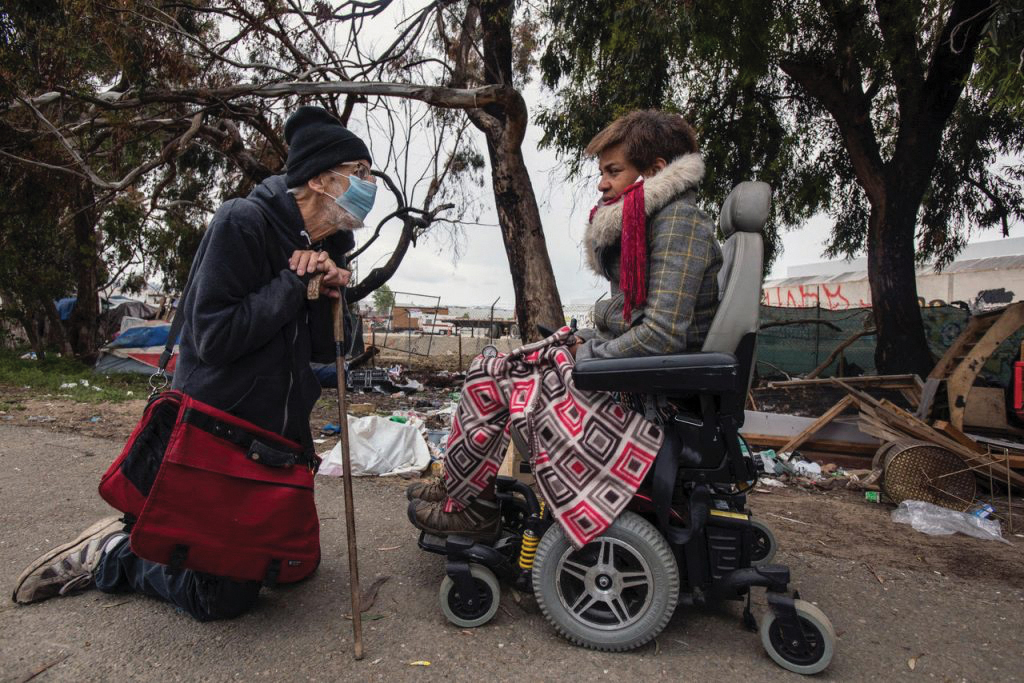
BP: What do you make of the intersections taking place in West Berkeley right now, the building tension between encampments and new development?
ON: Gentrification is a huge part of what we’re talking about. It’s [happening] in Berkeley and Oakland, it’s all over. The elements moving in, those who can afford the prices of new buildings, they don’t have relatives who are homeless. They’re mostly White—or they’re not Black—they’re not poor, and when you spend all this money on a fancy condo, you don’t want to look out onto the street and see some homeless person sprawled out on the sidewalk. They just don’t want to see it or think about it.
Berkeley and parts of Oakland have gotten whiter, and more rich, and that has a major impact. A vastly disproportionate number of Black people are homeless. They’re getting pushed out of these towns, but to where? So the war on encampments continues in places like Oakland and Berkeley. And with what’s been coming down from the Trump administration—with their new regulations and funding cuts to [HUD’s] Continuum of Care [program]—that’s going to put a whole lot more people out on the street.
And with increased criminalization, there could be a real qualitative change coming—a change significantly for the worse. Older and disabled people who’ve been inside for years will be kicked back out on the street. People in these so-called transitional housing places will have nowhere to transition to. And at a time when the major response—from cities, countries, and now the [federal government]—is criminalization. It’s not a pretty picture.
BP: How could constitutional rights factor into protecting homeless people during this surge of criminalization?
ON: The problem for homeless people, in particular, is the Constitution is not a document that contains an affirmative right to life, liberty, and happiness—that’s in the Declaration of Independence. The UN’s Universal Declaration of Human Rights has never been adopted by the United States, it’s not a treaty we have to abide by. So there’s no right to housing. There’s no right to health. No right to meaningful work, leisure, or shelter from the rain. None of those crucial rights are in the Constitution.
So it’s hard to imagine how to exercise rights you do have if your right to life is not allowed. The right to speech is fine, but if you’re starving and freezing in the rain, the right to speak is not the right you’re concerned about. What you want is warmth, but none of that is in the Constitution.
The problem is that lawyers argue to protect human rights with a Constitution that does not contain protections for human rights—it was written to protect against actions by the government that infringe on due process, seizure of property, and so on…but lawyers are not going to solve our social problem here. They’re not going to prevent this raging attack against homeless people, they’re not going to change the obscene inequalities in this society.
They’ll do what they can do. But really, the [legal] defense has to be part of the larger project to make the society more equal and just. And that is a major revolutionary project.
BP: Spell that out for me. What is needed to affect real and equitable change?
ON: We have to fight for change on every level, and the people who should be in the lead are the people who are most affected. Locally, there are incredible advocates in Oakland and Berkeley fighting against increased criminalization. From Wood Street Commons, Where Do We Go?, Berkeley Homeless Union…they’re fighting, and every ounce of energy is spent trying to survive. This is very difficult, they need allies. More and more, Bay Area cities are becoming exclusive domains of privileged people with money—White people, not Black. Black people are being pushed out, and a push back has to happen. On the city, county, and state level.
On a larger level, we have to fight against fascism. What Trump is doing is manically crazy and destructive, and impacts every millimeter of our society. But specifically with these latest regulations, they are coming down on homeless people and they’re going to make life so much worse. They want to incentivize criminalization and de-incentivize housing for people. There are going to be many more people out on the streets, and that has to be fought. So on every level, these fights are all connected.
I think [affecting change requires] more than just [lawsuits]. This has to be traditional organizing, and it has to be organized across class lines.
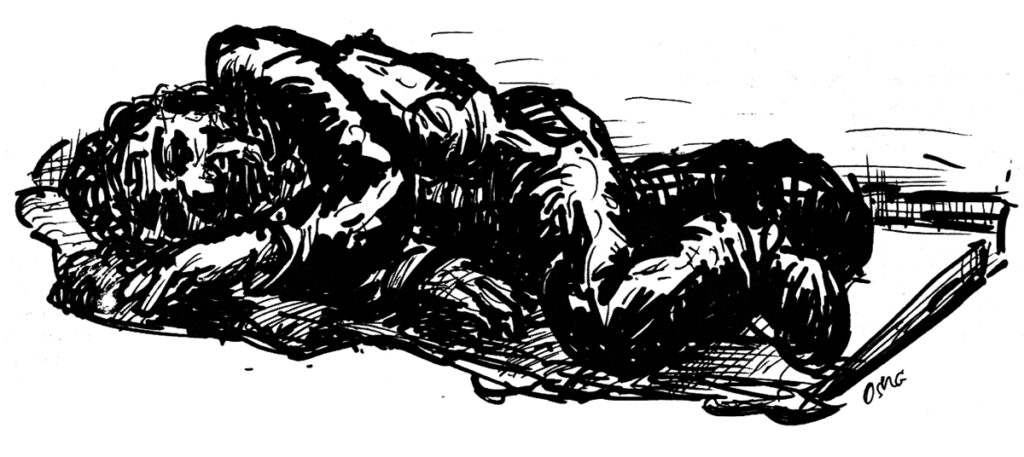
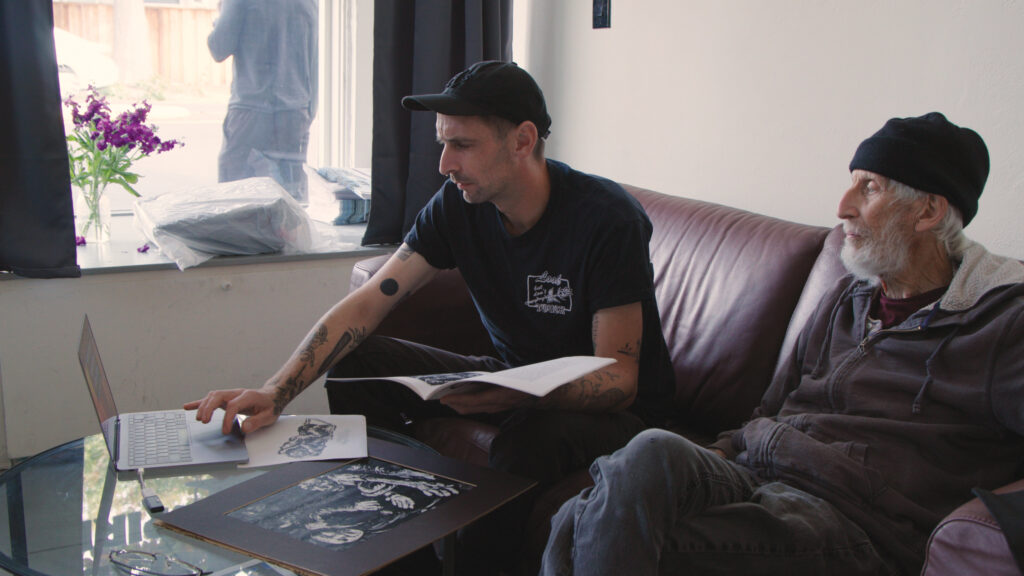
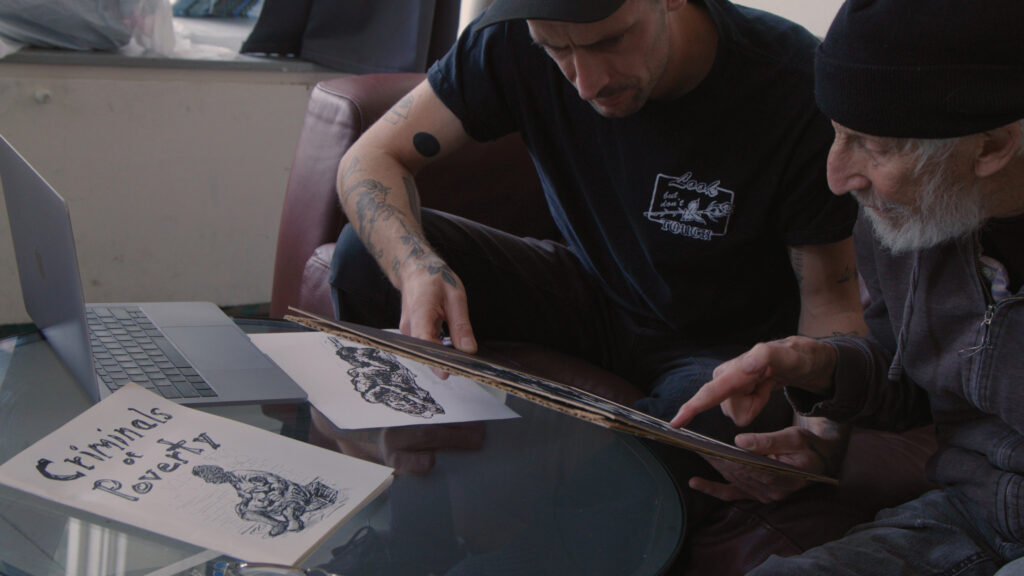
A drawing by Osha Neumann depicting an unhoused person sleeping on the sidewalk, first published in Street Spirit Vol. 1, No. 4, June 1995.
Bradley Penner is the Editor and Lead Reporter of Street Spirit.