
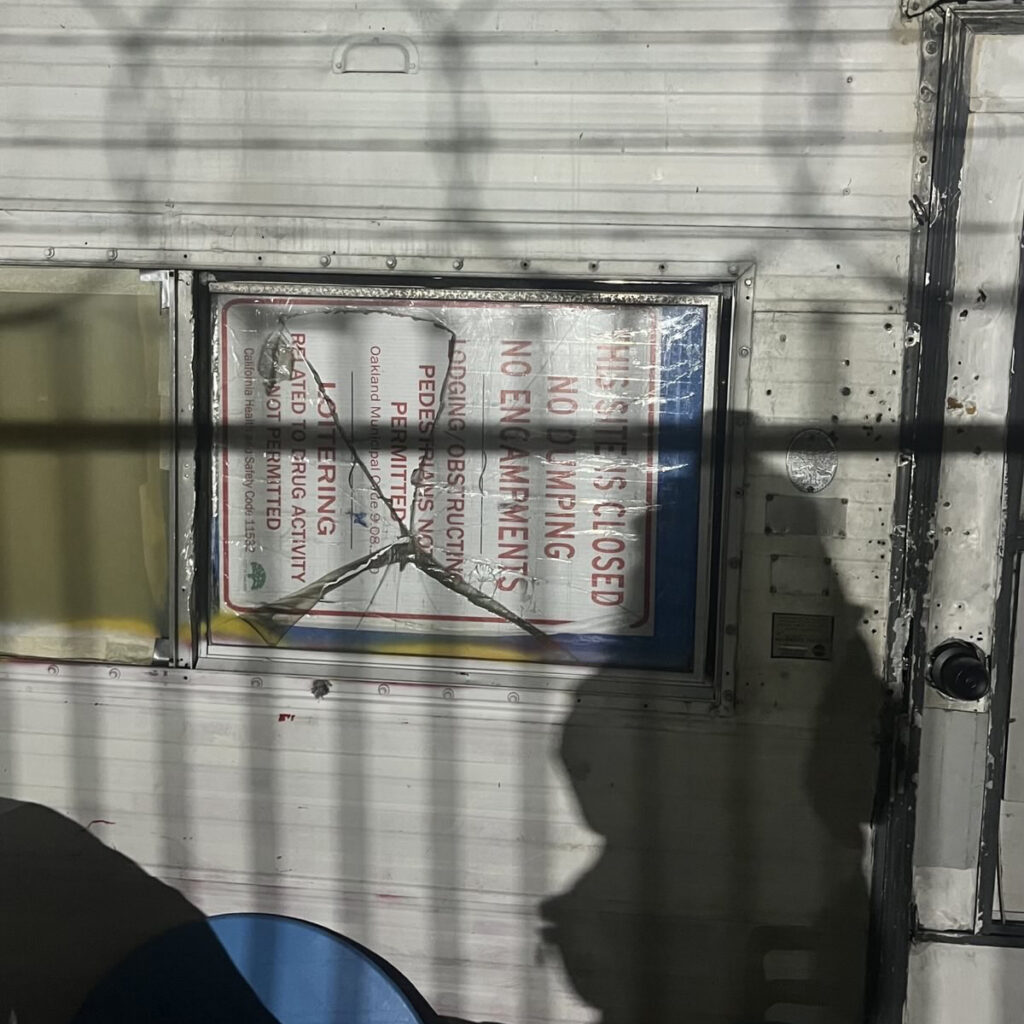
I remember the first time I observed a row of “tagged” RVs. It was a Friday in December 2024, and the row stretched so far I couldn’t see the end of the line. A friend and I had received word that the stretch of vehicular homes on East 9th Street had been scheduled to be swept over the weekend. The Oakland Police Department had just come by to tag each vehicle with a bright orange notice, giving them 72 hours to move or be towed.
At that point, I had been showing up to the city’s daily encampment evictions—or “sweeps”—for almost a year, simply to ask what people needed. Time and time again I joined neighbors and friends in offering support to those affected, rooted in a sense of justice and community.
Every day the city swept—trashing people’s belongings, towing their RVs, and offering unreliable housing options that often created more precarity than stability—we offered to help people keep their belongings, their shelter, their pets.
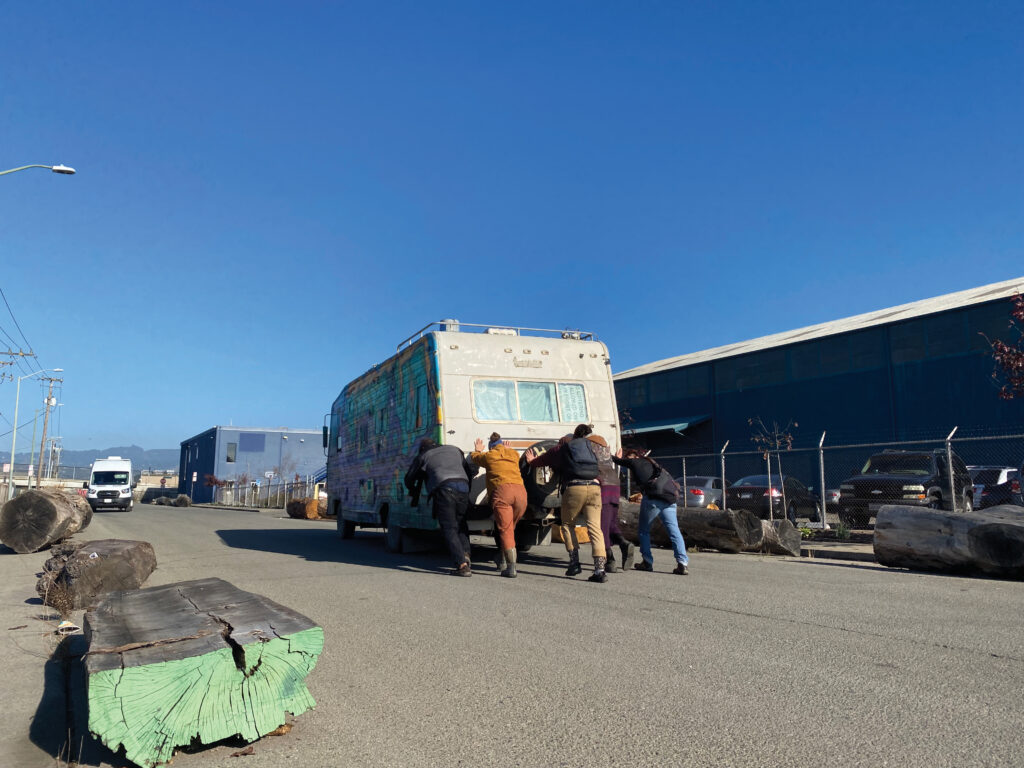
In contrast to any nonprofit or government setting I’ve ever been in, I grew to love the daily act of creatively meeting people’s expressed needs. Sometimes it’s towing a non-operable vehicle with what tools, tires, and vehicles we had available. Sometimes it’s delivering a meal. Sometimes it’s an ask to share their personal story or fundraiser on the Oakland Revealed Instagram account. That weekend in December 2024, the need was for more than 15 RVs to immediately move from a public street where folks had been living for years.
The next three days were absolute chaos. On Saturday, OPD rolled through again and ordered RV residents to move right away, then left for another 24 hours. For some reason, police told encampment residents their housing placements would be discussed at a city council meeting the following Monday, which was not only untrue, but also a gross misrepresentation of a long and messy process to approve housing resources. Confused and fearful of losing their homes, residents and neighbors stayed up around the clock, towing and moving things with what little resources were available.
Together, we did much more than we believed possible, but these street-level experiences take a huge physical and emotional toll. That Friday, after hearing how nonsensically OPD was moving through the encampment, I looked out at the RVs along East 9th Street in a panic. Inoperable mobile homes, the only shelter some of our neighbors have, are enormously difficult to move. We had no idea how we were going to stretch to meet the city’s escalations around “emergency” sweeps. I sat with my friend in the car later that night, trying to understand the enormity and find a way forward.
“One at a time,” I remember saying, almost chanting. “Every single one is worth it. We’ll just move them one at a time.”
Over time—and one at a time—I’ve been learning with my neighbors deep inside the sweep zone that the city’s escalations are steadily worsening.
Oakland’s current “Encampment Management Policy” states that city workers cannot close an encampment without providing shelter offers to residents they displace. But in June 2024, the Supreme Court’s Grants Pass ruling held that, even without a shelter offer of any kind, local governments can criminalize sleeping or camping in public spaces. This has created a gray area of accountability to the city’s own policies—often without any legal recourse.
In the months after Grants Pass, and emboldened by California Governor Gavin Newsom’s embrace of the ruling, former Oakland Mayor Sheng Thao issued an executive order in September 2024 that established new “emergency closure” criteria for encampments. The order not only allows the city to conduct “immediate closures” with as little as 12-hour’s notice, but also demands that Oakland’s limited shelter capacity will “in no case” halt its sweep operations.
Now, in October 2025, city officials are considering the adoption of a new policy that will further criminalize unhoused Oaklanders who find and build shelter on our city’s streets.
Over the last month, advocates have been organizing against the so-called “Encampment Abatement Policy” (EAP) introduced in city hall by District 7 Councilmember Ken Houston. The EAP—which would replace the current Encampment Management Policy—allows OPD the power to determine “emergency closure” status of an encampment, formalizes the city’s right to close encampments without offering shelter, and allows for the arrest of individuals who re-encamp in closed locations. Hidden at the bottom of Houston’s draft proposal is a clause stating that individuals who decline shelter offers are also subject to citation or arrest, a tactic could easily be weaponized to imprison and disappear our unhoused neighbors.
Additionally, RVs and live-in vehicles are markedly removed from encampment status under this new policy, effectively banning mobile homes in Oakland under existing municipal parking codes. Rather than categorizing these vehicles as shelters within an encampment, they would be considered mere objects that are subject to enforcement and towing by OPD.
On September 10, over 100 housed and unhoused Oaklanders mobilized to attend the city council’s bi-monthly Public Safety Committee in opposition to Houston’s policy. After 93 people spoke during public comment, the committee decided to delay its consideration of the proposal, which would need amendments and approval before moving to a vote at Oakland City Council. At press time, it was unclear when the proposal will be revisited by the Public Safety Committee.
But in the weeks following the committee meeting, OPD has conducted two raids on RV encampments in West Oakland with no notice at all. According to homeless neighbors on Poplar Street, OPD officers have been justifying the sweeps by saying the EAP has already been passed into law. During the OPD-led operation, three RVs were towed and one advocate was arrested. The police offered no regard for the property, rights, or lives of those who were targeted—a glimpse in the direction we are headed if the new policy is adopted.
At its core, the Encampment Abatement Policy intends to shift encampment operations from the Department of Public Works to OPD, who will be given more power to police our most vulnerable neighbors and friends. Instead of pretending to lead encampment operations under the guise of public health or accessibility, police will set out to criminalize poverty as part of our institutional shift toward fascism. They will lie and incite fear. They will funnel people into slave labor and systematic sexual violence through prisons, some disguised as mental health facilities. They will serve the larger vision of racial capitalism in a rapidly changing city—an Oakland where supposed public space has no public use; where our disproportionately Black, elderly, and disabled neighbors are continually displaced from their homes; where homeless people fear for their lives and flee Oakland, leaving their families that are rooted here; where people disappear from the only streets they have known their entire lives.
The only defense is to organize. At encampment sweeps, at city council, in our neighborhoods, standing down the guns, providing material and emotional support, building trust and safety between us. The police have none to offer, and the window in which the government offers even nonsensical, mismanaged, disrespectful versions of public services is closing. We can and have built safety among ourselves, and we are always capable of organizing into self-determining communities where we meet our basic needs together. The only defense is to organize.
Sunflower is an organizer, poet, and writer who spends time at sweeps.